Wellness Wednesday – Week 34

Cold, Flu, or Allergy?
Know the Difference for Best Treatment

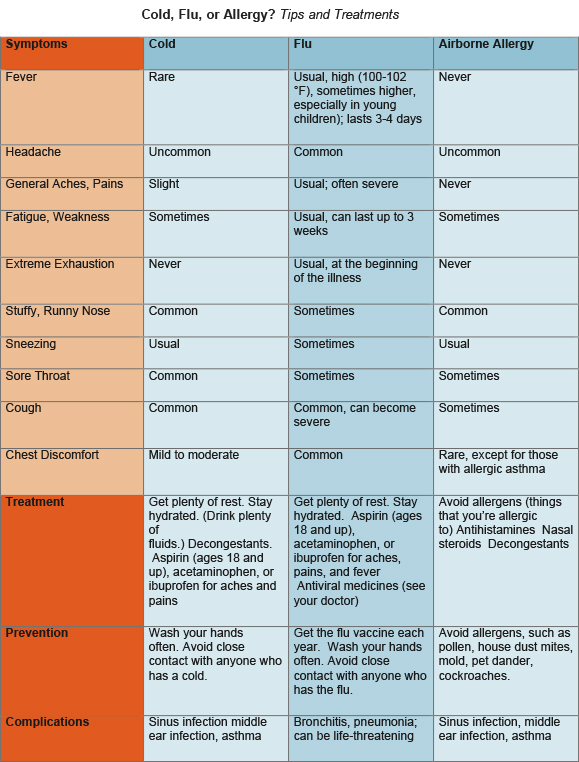
You’re feeling pretty lousy. You’ve got sniffles, sneezing, and a sore throat. Is it a cold, flu, or allergies? It can be hard to tell them apart because they share so many symptoms. But understanding  the differences will help you choose the best treatment.

“If you know what you have, you won’t take medications  that you don’t need, that aren’t effective, or that might even make your symptoms worse,” says NIH’s Dr. Teresa Hauguel, an expert on infectious diseases that
affect breathing.

Cold, flu, and allergy all affect your respiratory system, which can make it hard to breathe. Each condition has key symptoms that set them apart.

Colds and flu are caused by different viruses. “As a rule of thumb, the symptoms associated with the flu are more severe,” says Hauguel. Both illnesses can lead to a runny, stuffy nose; congestion; cough; and sore throat. But the flu can also cause high fever that lasts for 3-4 days, along with a headache, fatigue, and general aches and pain. These symptoms are less common when you have a cold.

“Allergies are a little different, because they aren’t caused by a virus,” Hauguel explains. “Instead, it’s your body’s immune system reacting to a trigger, or allergen, which is something you’re allergic to.” If you have allergies and breathe in things like pollen or pet dander, the immune cells in your nose and airways may overreact to these harmless substances. Your delicate respiratory tissues may then swell, and your nose may become stuffed up or runny.

“Allergies can also cause itchy, watery eyes, which you don’t normally have with a cold or flu,” Hauguel adds.

Allergy symptoms usually last as long as you’re exposed to the allergen, which may be about 6 weeks during pollen seasons in the spring, summer, or fall. Colds and flu rarely last beyond 2 weeks.

Most people with a cold or flu recover on their own without medical care. But check with a health care provider if symptoms last beyond 10 days or if symptoms aren’t relieved by over-the-counter  medicines. For more about when to see a doctor, go to CDC’s Flu Page .

To treat colds or flu, get plenty of rest and drink lots of fluids. If you have the flu, pain relievers such as aspirin, acetaminophen,  or ibuprofen can reduce fever or aches. Allergies can be treated with antihistamines or decongestants.  See the “Wise Choices” box for more details.

Be careful to avoid “drug overlap” when taking medicines that list 2 or more active ingredients on the label. For example, if you take 2 different drugs that contain acetaminophen—one for a stuffy nose and the other for headache—you  may be getting too much acetaminophen.

“Read medicine labels carefully—the warnings, side effects, dosages. If you have questions, talk to your doctor or pharmacist, especially if you have children who are sick,” Hauguel says. “You don’t want to overmedicate, and you don’t want to risk taking a medication that may interact with another.”
Cold Flu Allergy-3

http://newsinhealth.nih.gov/issue/oct2014/feature2

Wellness Wednesday – Week 33

String May Work Better Than BMI In Determining Body Fat, Health Risks

May 12, 2015

By Anthony Rivas

More research is beginning to show BMI isn’t as accurate at determining health as we once thought. String may work better.

For over a century, doctors have been improving on the body mass index (BMI), their go-to method for determining whether a person has an unhealthy amount of body fat. Still, few changes have been made over the last few decades, even as medical knowledge improves. Scientists are beginning to realize body mass index may not be the best indicator of a person’s fat level or the best predictor of their risk for health problems like heart disease. Instead of using BMI, a group of researchers from the UK say string will do just fine.

You read that right. String. And it’s not as far-fetched as it sounds, either. BMI is a calculation of a person’s weight status based on their weight and height, which then categorizes a person as either underweight, normal weight, overweight, or obese. However, such a basic measurement fails to account for where in the body the fat is located, and that’s important when we consider that there are two kinds of fat: brown, the good fat that insulates us, and white, which stores energy and contributes to obesity. With BMI, all of this fat is considered equal.

In their new study, researchers from Oxford Brookes University suggested a new method that’s been gaining acceptance of late: waist-to-height ratio (WHtR). They found that measuring a person’s height with string, then folding the string in half and seeing if it’ll fit around a person’s waist comfortably could be a better indicator of whether a person is overweight, Yahoo Health reported. This is because white fat tends to preside mostly in the abdomen, whereas brown fat hangs out elsewhere in the body. Having too much white fat around the abdomen has been linked to heart disease, diabetes, and other metabolic disorders.

For the study, researchers looked at data from the Health Survey for England
2009, which looked at the health of nearly 3,000 people. They found that

“12 percent of the total population would be missed by BMI screening, and over a third of those classified as ‘normal’ by BMI would have a WHtR exceeding 0.5” — anything over that and the patient is at a heightened risk of cardiovascular disease, a press release said. “These could be called non- overweight ‘apples,’ who have a lot of fat around the waist but not a high BMI.”

Arguing in favor of the string method, lead researcher Margaret Ashwell told Yahoo Health: “The science about the limitations of BMI and the superiority of waist-to-height ratio has been growing in leaps and bounds recently.” One study from 2013, for example, found that larger waistlines correlated with lower life expectancies. With BMI being the “convention,” however, researchers said it will take time and more research before doctors begin adopting a new method.

In the press release, the researchers said, “We would like to show that WHtR is not only superior to BMI in first stage screening for the health risks of obesity, but it is also more efficient in practice and can be done by personnel with minimal training and resources.”

Source: Ashwell M, Gibson S. A proposal for a primary screening tool:
‘Keep your waist circumference to less than half your height.’ BMC Medicine. 2015.

http://www.medicaldaily.com/string-­‐may-­‐work-­‐better-­‐bmi-­‐determining-­‐body-­‐fat-­‐
health-­‐risks-­‐333060

Wellness Wednesday – Week 32

Negative Consequences of Obesity

Did you know that…

Obesity has more negative health consequences than smoking?

67% of the U.S. population is overweight/obese?

An overweight or obese employee’s health care costs are more than one third higher each year than the health care costs of a healthy weight individual?

This information came from Weight Watchers and that’s why the STARS Employee Healthcare Program would like to offer Weight Watcher classes to all TRC employees.  Depending on interest, we would like to offer either a 12 or 17 week class both in Jamestown and Dunkirk.  Employees can pay for this by payroll deduction, cash, check, or credit card.  This cost can be reimbursed using FSA monies with written documentation from a Doctor.  A discount for this class will be applied to any STARS enrolled employee, amount to be determined.

If interested in attending Weight Watchers, please email or call Donna Trusso, STARS Project Manager, at 661-4795 at your earliest convenience.  I look forward to hearing from you soon!

Stay well!

Wellness Wednesday – Week 31

Computer & Desk Stretches

Basic recommendations from the American College of Sports Medicine suggest that adults engage in flexibility exercises at least two to three days a week to help improve range of motion, performance, and activities of daily living.

Here are some stretches that can help you follow this recommendation while at work. Stretching can help reduce pain and stiffness caused by sitting at a desk for long periods of time.
Print this worksheet and keep a copy in your drawer, or bookmark this website and add to your favorites for ease of return. These stretches can be done regularly throughout the day about every 30 minutes. In addition it is helpful to take time to get up and walk around regularly.

Sitting Stretch for Upper Body:

Sit upright in your chair and straighten your arms out in front of you with you fingers laced.
You should feel this stretch in your arms and your upper back. Hold stretch for 20 seconds, do at least twice.

Arms/Shoulders/Upper Back Stretch

Interlace your fingers and raise your arms above your head with your palms facing up. To feel the stretch, try to push your arms up and back. You should feel this stretch in your arms, shoulders, and upper back . Hold for 15 seconds. Try to breathe deeply and do not hold your breath.

Shoulder and Side Stretch

Bend your right elbow placing your arm behind your head. Hold right elbow with your left hand. To stretch armpit/shoulder area, move back of head against right arm until mild stretch is felt. Hold for 10-15 seconds. Do both sides. To extend stretch further down your side
and into your hip, bend knees slightly and gently pull your elbow behind your head as you bend
from your hips to the side. Hold for 10 seconds.

Shoulder Blade Pinch

Sit up straight in your chair and relax your shoulders. Place your hands behind head, interlace your fingers, and pull your shoulder blades together. Hold for 4-5 seconds. You should feel this stretch in your shoulders, upper back, and even a little in the pectoral (chest) muscles as your chest moves upwards when you work to squeeze your shoulder blades together. Repeat 3-4 times.

Shoulder Shrug

Start with shoulders relaxed and arms hang-ing to the side. Shrug shoulders up as high as possible without bend-ing your elbows. You should feel slight tension in your neck and shoulders. Hold for 5 seconds. Then, relax your shoulders back down. Repeat 2 – 3 times.

Neck Stretch

With hands behind your back, grab your left wrist with your right hand. Tilt your head to the side to-ward your right shoulder as your right hand pulls your left arm down and across. Hold for 10-15 seconds. Do both sides.

Wrist Flexor Stretch

Similar to previ-ous stretch. Start with arms down in front of you and your palms together with fingers pointing down. Slowly bend elbows bringing your hands upward. Go until you feel a mild stretch in your wrists and fore-arms. Keep your elbows up and even. Hold for 5-8 seconds.

Reaching Upper Body Stretch

Reach in opposite directions with your arms while sitting. Hold for 10 seconds each side. Keep your jaw relaxed and breathe rhythmically. This stretches the sides of the upper body, shoulders, and arms.

Wrist Flexor Stretch

Place your hands together in front of you with fingers up and elbows out. Then, push your hands together and down, keeping your palms together, until you feel a mild stretch in your wrist and forearms. Keep your el-bows up and even. Hold for 5-8 seconds.

Hand Shakes

Shake your arms and hands at your side for 10-12 sec-onds. Keep your jaw re-laxed and let your shoul-ders hang downward as you shake out tension.

Back Extension Stretch

Sitting on the edge of your chair, place your palms on your lower back just above your hips, fingers pointed downward. Gently push your palms forward to create an extension in the lower back. This stretches the lower back and stretch can also be felt in the chest and shoulder area. Hold for 10 seconds. Repeat twice. Use this stretch after sitting for an extended period of time. Do not hold your breath.

Lower Back and Side Hip Stretch

In a sitting position cross your left leg over the outside of your right knee. Turn your shoulders to your left using your right hand to push against your left knee while your left hand pushes against the back of your chair. Exhale slowly and turn your head to look over your left shoulder. Hold for 10-15 seconds. Do both sides.

Wellness Wednesday – Week 30

Have you visited MYPLATE.gov lately?

Healthy tips on Eating, Recipes, Vegetarians, Eating Out, Food Safety, and more.

Starting Points

Your food and physical activity choices each day affect your health — how you feel today, tomorrow, and in the future.

These tips and ideas are a starting point. You will find a wealth of suggestions by going to this site and clicking on the bullet points to get more information on how to get started towards a healthy diet and a healthier you! Try one change that you can make today.

  • Make at least half your grains whole grains
  • Vary your veggies
  • Focus on fruit
  • Get your calcium-rich foods
  • Go lean with protein
  • Get more healthy eating tips

Want more information?  Go to  http://choosemyplate.gov/healthy-eating-tips.html

  1. 10 Tips Nutrition Education Series
  2. Recipes, Cookbooks, and Menus
  3. Tips for Vegetarians
  4. Tips for Eating Healthy When Eating out
  5. Counting Calories in Mixed Dishes
  6. Food Safety Advice
  7. Tips for Increasing Physical Activity

Wellness Wednesday – Week 29

Need Medical Care Right Away and You Cannot Get In to See Your Primary Care Doctor?

Did you know:

When you are sick, or have an unexpected occurrence, or a condition that warrants immediate attention, it is critical to seek medical care.   If you have an acute health issue that needs attention and you cannot get into your Primary Care Doctor right away did you know, that you can access our TRC Primary Care Clinic if you have Independent Health?

What are the benefits?

  • As a TRC employee or family member, you will be able to get an appointment the same day.
  • No referral is needed.
  • You will not be charged a co-pay!
  • You do not have to change your Primary Care Doctor to see our clinician at TRC Primary Care.
  • TRC Primary Care will treat you for immediate care and refer you to your Primary Care Doctor for follow-up care.
  • You receive the care needed.

CALL TRC PRIMARY CARE FOR AN APPOINTMENT: 661-1447

If you have any questions about TRC Primary Care Clinic or if you have other insurance contact: Pam Marchincin at 969-3036.

Wellness Wednesday – Week 28

For Every Hour You Sit, Get up and Move for 2 Minutes!

A study published in the Clinical Journal of the American Society of Nephrology (CJAMSN) suggests that for every hour of sedentary activity (sitting at your desk, for example) we should do two (2) minutes of light-intensity activity (like walking).  WHY?  The outcome of the study stated that doing so was linked to a 33% lower mortality in the general population and a 41% lower mortality rate in those with chronic kidney disease based on the observational analysis published April 30th (see http website below).

Previous studies have suggested that sitting for long periods may increase the risk for chronic disease and early death.  So… don’t risk getting a chronic disease or an early death!  We want you around for a long time.  If you have been sitting at your desk for an hour and are reading this article, get up and walk for 2 minutes. Live well, live longer.

http://cjasn.asnjournals.org/content/early/2015/04/29/CJN.08410814.abstract

Wellness Wednesday – Week 26

Differences between men and women can make important differences in women’s medical care.

According to an article in *How’s your Health regarding Women’s Issues are as follows:

  • Womens’ smaller size generally makes women more prone to the effects (and harmful effects) of medications, alcohol, and cigarettes.
  • Depending on a woman’s age and reproductive status, women also need different amounts of calcium, iron, and folic acid than men.
  • Normal hormone cycles make women more likely to have worsening of some problems.  For example, headaches and acne may get worse before menstruation.
  • Similar health problems may present differently.  For example women who are having a heart attack seem more likely to have upper abdomen pain, sickness to stomach or shortness of breath than men.

Learn more on Women’s Issues Chapter 14
https://www.howsyourhealth.org/

Wellness Wednesday – Week 25

How’s Your Health?

A Personal Guide for Health and Medical Care that is easy to use and works!

  • Learn to be confident to be able to control and manage your health!
  • Get tips and support for healthy living and making good health decisions!
  • Learn about recommended prevention based on information tailored to your needs!

Where do I get this information?

https://www.howsyourhealth.org/

Wellness Wednesday – Week 24

SuperTracker: My foods. My fitness. My health.

Get your personalized nutrition and physical activity plan. Track your foods and physical activities to see how they stack up.  Get tips and support to help you make healthier choices and plan ahead. https://www.supertracker.usda.gov.

You can:

  • Learn how much to eat for a weight goal you have in mind.
  • Personalize your experience by creating your profile, and get a plan tailored for you
  • Look up nutrition info for over 8,000 foods and compare foods side-by-side.
  • Track the foods you eat and compare to your nutrition and calorie targets.
  • Enter your physical activities and track your progress.
  • Get weight management guidance; enter your weight and track progress over time.
  • Choose up to 5 personal goal
  • Sign up for tips and support from your virtual coach.
  • Build and save your favorite recipes for tracking, and analyze the nutrition info.