Wellness Wednesday – Week 35

What Your Cholesterol Levels Mean

How’s your cholesterol? Time to get it checked!

Keeping your cholesterol levels healthy is a great way to keep your heart healthy – and lower your chances of getting heart disease or having a stroke.    But first, you have to know your cholesterol numbers. The American Heart Association recommends all adults age 20 or older have their cholesterol, and other traditional risk factors, checked every four to six years.

Your test report will show your cholesterol levels in milligrams per deciliter of blood (mg/dL). Your total cholesterol and HDL (good) cholesterol are among numerous factors your doctor can use to predict your lifetime or 10-year risk for a heart attack or stroke.

To determine how your cholesterol levels affect your risk of heart disease, your doctor will also take into account other risk factors such as age, family history, smoking and high blood pressure.

A complete fasting lipoprotein profile will show the following for:

Total blood (or serum) cholesterol Your total cholesterol score is calculated using the following equation: HDL + LDL + 20 percent of your triglyceride level.

HDL (good) cholesterol With HDL cholesterol, higher levels are better. Low HDL cholesterol puts you at higher risk for heart disease. People with high blood triglycerides usually also have lower HDL cholesterol. Genetic factors, type 2 diabetes, smoking, being overweight and being sedentary can all result in lower HDL cholesterol.

LDL (bad) cholesterol A low LDL cholesterol level is considered good for your heart health. However, your LDL number should no longer be the main factor in guiding treatment to prevent heart attack and stroke, according to new guidelines from the American Heart Association. For patients taking statins, the guidelines say they no longer need to get LDL cholesterol levels down to a specific target number. A diet high in saturated and trans fats raises LDL cholesterol.

Triglycerides Triglyceride is the most common type of fat in the body. Normal triglyceride levels vary by age and sex. A high triglyceride level combined with low HDL cholesterol or high LDL cholesterol is associated with atherosclerosis, the buildup of fatty deposits in artery walls that increases the risk for heart attack and stroke.

AHA Recommendation We recommend that all adults age 20 or older have their cholesterol and other traditional risk factors checked every four to six years, and work with their healthcare providers to determine their risk for cardiovascular disease and stroke.

Source – http://www.heart.org/HEARTORG/Conditions/What-Your-Cholesterol-Levels-Mean_UCM_305562_Article.jsp

The Top 5 Cholesterol Myths

Even if you think you know everything there is to know about cholesterol, there may be a few more surprises in store. Check out these common myths about high cholesterol; find out whos most likely to have it, what types of food can cause it, and why—sometimes— cholesterol isn’t a bad word.

Myth 1: Americans have the highest cholesterol in the world
One of the world’s enduring stereotypes is the fat American with cholesterol-­‐clogged
arteries who is a Big Mac or two away from a heart attack. As a nation, we could certainly use some slimming down, but when it comes to cholesterol levels we are solidly middle-­‐of-­‐ the-­‐road.

According to 2005 World Health Organization statistics, American men rank 83rd in the world in average total cholesterol, and American women rank 81st; in both cases, the average number is 197 mg/dL, just below the Borderline-­‐High Risk category. That is very respectable compared to the top-­‐ranked countries: In Colombia the average cholesterol among men is a dangerous 244, while the women in Israel, Libya, Norway, and Uruguay are locked in a four-­‐way tie at 232.

Myth 2: Eggs are evil
It’s true that eggs have a lot of dietary cholesterol—upwards of 200 mg, which is more than
two-­‐thirds of the American Heart Association’s recommended limit of 300 mg a day. But dietary cholesterol isn’t nearly as dangerous as was once thought. Only some of the cholesterol in food ends up as cholesterol in your bloodstream, and if your dietary cholesterol intake rises, your body compensates by producing less cholesterol of its own.

While you don’t want to overdo it, eating an egg or two a few times a week isn’t dangerous.
In fact, eggs are an excellent source of protein and contain unsaturated fat, a so-­‐called good
fat.

Myth 3: Kids can’t have high cholesterol
Most people think high cholesterol is a problem that’s strictly for the middle-­‐aged. But guess what? Research has shown that atherosclerosis—the narrowing of the arteries that leads to heart attacks—can start as early as age eight. In July 2008, the American Academy of Pediatrics released guidelines on kids and cholesterol that recommended that children who are overweight, have hypertension, or have a family history of heart disease have their cholesterol tested as young as two years of age.

Children with high cholesterol should be on a diet that restricts saturated fat to 7% of
calories and no more than 200 mg per day of dietary cholesterol, according to the
guidelines. Fiber supplements and more exercise are also recommended.

While the guidelines prompted a bit of an outcry from parents worried that doctors would be pushing cholesterol-­‐lowering drugs for kids, a new study suggests that less than 1% of adolescents aged 12 to 17 would be considered candidates for medication.

Myth 4: Food is heart-­healthy if it says “0 mg cholesterol”
The Cholesterol portion of the nutritional label refers to dietary cholesterol, which is only one of the things found in food that can cause your cholesterol to go sky-­‐high. (A bigger contributor to elevated cholesterol? A high-­‐fat diet.) It’s also believed to be the least important. Saturated fat (found in animal foods and dairy products) and trans fats (found in packaged foods) appear to have a far greater impact on low-­‐density lipoprotein (LDL), the so-­‐called bad cholesterol that causes atherosclerosis, than dietary cholesterol.

Myth 5: Cholesterol is always a bad thing
When most people hear “cholesterol” they think “bad.” Like most things in life, the reality is more complex. High cholesterol can be dangerous, but cholesterol itself is essential to various bodily processes, from insulating nerve cells in the brain to providing structure for cell membranes. That’s why your body makes the white, waxy substance (about 75% of the cholesterol in your blood is made by the liver and cells elsewhere in your body).

The role of cholesterol in heart disease is often misunderstood. Cholesterol is carried through the bloodstream by low-­‐density and high-­‐density lipoproteins (LDL and HDL). LDL, known as bad cholesterol, and not the cholesterol it carries per se, is responsible for atherosclerosis.

http://www.health.com/health/condition-­‐article/0,,20259746_2,00.html

Wellness Wednesday – Week 34

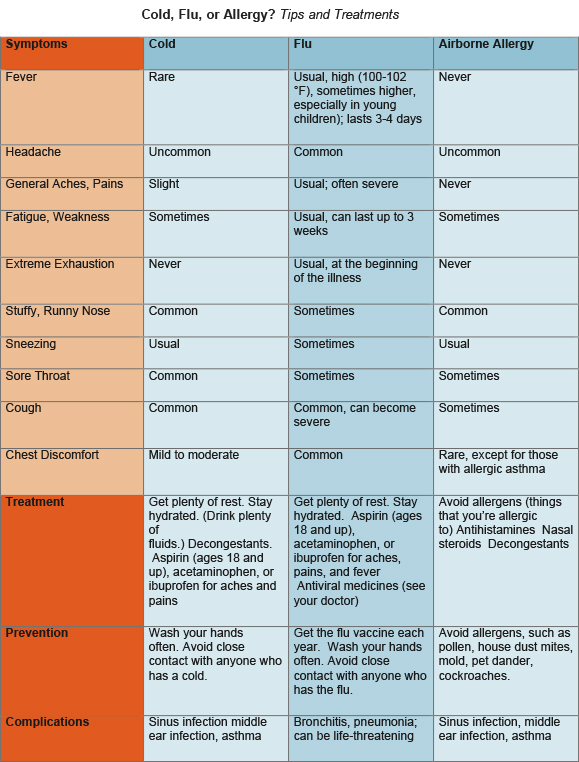
Cold, Flu, or Allergy?
Know the Difference for Best Treatment

You’re feeling pretty lousy. You’ve got sniffles, sneezing, and a sore throat. Is it a cold, flu, or allergies? It can be hard to tell them apart because they share so many symptoms. But understanding  the differences will help you choose the best treatment.

“If you know what you have, you won’t take medications  that you don’t need, that aren’t effective, or that might even make your symptoms worse,” says NIH’s Dr. Teresa Hauguel, an expert on infectious diseases that
affect breathing.

Cold, flu, and allergy all affect your respiratory system, which can make it hard to breathe. Each condition has key symptoms that set them apart.

Colds and flu are caused by different viruses. “As a rule of thumb, the symptoms associated with the flu are more severe,” says Hauguel. Both illnesses can lead to a runny, stuffy nose; congestion; cough; and sore throat. But the flu can also cause high fever that lasts for 3-4 days, along with a headache, fatigue, and general aches and pain. These symptoms are less common when you have a cold.

“Allergies are a little different, because they aren’t caused by a virus,” Hauguel explains. “Instead, it’s your body’s immune system reacting to a trigger, or allergen, which is something you’re allergic to.” If you have allergies and breathe in things like pollen or pet dander, the immune cells in your nose and airways may overreact to these harmless substances. Your delicate respiratory tissues may then swell, and your nose may become stuffed up or runny.

“Allergies can also cause itchy, watery eyes, which you don’t normally have with a cold or flu,” Hauguel adds.

Allergy symptoms usually last as long as you’re exposed to the allergen, which may be about 6 weeks during pollen seasons in the spring, summer, or fall. Colds and flu rarely last beyond 2 weeks.

Most people with a cold or flu recover on their own without medical care. But check with a health care provider if symptoms last beyond 10 days or if symptoms aren’t relieved by over-the-counter  medicines. For more about when to see a doctor, go to CDC’s Flu Page .

To treat colds or flu, get plenty of rest and drink lots of fluids. If you have the flu, pain relievers such as aspirin, acetaminophen,  or ibuprofen can reduce fever or aches. Allergies can be treated with antihistamines or decongestants.  See the “Wise Choices” box for more details.

Be careful to avoid “drug overlap” when taking medicines that list 2 or more active ingredients on the label. For example, if you take 2 different drugs that contain acetaminophen—one for a stuffy nose and the other for headache—you  may be getting too much acetaminophen.

“Read medicine labels carefully—the warnings, side effects, dosages. If you have questions, talk to your doctor or pharmacist, especially if you have children who are sick,” Hauguel says. “You don’t want to overmedicate, and you don’t want to risk taking a medication that may interact with another.”

Cold Flu Allergy-3

http://newsinhealth.nih.gov/issue/oct2014/feature2

Wellness Wednesday – Week 33

String May Work Better Than BMI In Determining Body Fat, Health Risks

May 12, 2015

By Anthony Rivas

More research is beginning to show BMI isn’t as accurate at determining health as we once thought. String may work better.

For over a century, doctors have been improving on the body mass index (BMI), their go-to method for determining whether a person has an unhealthy amount of body fat. Still, few changes have been made over the last few decades, even as medical knowledge improves. Scientists are beginning to realize body mass index may not be the best indicator of a person’s fat level or the best predictor of their risk for health problems like heart disease. Instead of using BMI, a group of researchers from the UK say string will do just fine.

You read that right. String. And it’s not as far-fetched as it sounds, either. BMI is a calculation of a person’s weight status based on their weight and height, which then categorizes a person as either underweight, normal weight, overweight, or obese. However, such a basic measurement fails to account for where in the body the fat is located, and that’s important when we consider that there are two kinds of fat: brown, the good fat that insulates us, and white, which stores energy and contributes to obesity. With BMI, all of this fat is considered equal.

In their new study, researchers from Oxford Brookes University suggested a new method that’s been gaining acceptance of late: waist-to-height ratio (WHtR). They found that measuring a person’s height with string, then folding the string in half and seeing if it’ll fit around a person’s waist comfortably could be a better indicator of whether a person is overweight, Yahoo Health reported. This is because white fat tends to preside mostly in the abdomen, whereas brown fat hangs out elsewhere in the body. Having too much white fat around the abdomen has been linked to heart disease, diabetes, and other metabolic disorders.

For the study, researchers looked at data from the Health Survey for England
2009, which looked at the health of nearly 3,000 people. They found that

“12 percent of the total population would be missed by BMI screening, and over a third of those classified as ‘normal’ by BMI would have a WHtR exceeding 0.5” — anything over that and the patient is at a heightened risk of cardiovascular disease, a press release said. “These could be called non- overweight ‘apples,’ who have a lot of fat around the waist but not a high BMI.”

Arguing in favor of the string method, lead researcher Margaret Ashwell told Yahoo Health: “The science about the limitations of BMI and the superiority of waist-to-height ratio has been growing in leaps and bounds recently.” One study from 2013, for example, found that larger waistlines correlated with lower life expectancies. With BMI being the “convention,” however, researchers said it will take time and more research before doctors begin adopting a new method.

In the press release, the researchers said, “We would like to show that WHtR is not only superior to BMI in first stage screening for the health risks of obesity, but it is also more efficient in practice and can be done by personnel with minimal training and resources.”

Source: Ashwell M, Gibson S. A proposal for a primary screening tool:
‘Keep your waist circumference to less than half your height.’ BMC Medicine. 2015.

http://www.medicaldaily.com/string-­‐may-­‐work-­‐better-­‐bmi-­‐determining-­‐body-­‐fat-­‐
health-­‐risks-­‐333060

Wellness Wednesday – Week 32

Negative Consequences of Obesity

Did you know that…

Obesity has more negative health consequences than smoking?

67% of the U.S. population is overweight/obese?

An overweight or obese employee’s health care costs are more than one third higher each year than the health care costs of a healthy weight individual?

This information came from Weight Watchers and that’s why the STARS Employee Healthcare Program would like to offer Weight Watcher classes to all TRC employees.  Depending on interest, we would like to offer either a 12 or 17 week class both in Jamestown and Dunkirk.  Employees can pay for this by payroll deduction, cash, check, or credit card.  This cost can be reimbursed using FSA monies with written documentation from a Doctor.  A discount for this class will be applied to any STARS enrolled employee, amount to be determined.

If interested in attending Weight Watchers, please email or call Donna Trusso, STARS Project Manager, at 661-4795 at your earliest convenience.  I look forward to hearing from you soon!

Stay well!

Wellness Wednesday – Week 30

Have you visited MYPLATE.gov lately?

Healthy tips on Eating, Recipes, Vegetarians, Eating Out, Food Safety, and more.

Starting Points

Your food and physical activity choices each day affect your health — how you feel today, tomorrow, and in the future.

These tips and ideas are a starting point. You will find a wealth of suggestions by going to this site and clicking on the bullet points to get more information on how to get started towards a healthy diet and a healthier you! Try one change that you can make today.

  • Make at least half your grains whole grains
  • Vary your veggies
  • Focus on fruit
  • Get your calcium-rich foods
  • Go lean with protein
  • Get more healthy eating tips

Want more information?  Go to  http://choosemyplate.gov/healthy-eating-tips.html

  1. 10 Tips Nutrition Education Series
  2. Recipes, Cookbooks, and Menus
  3. Tips for Vegetarians
  4. Tips for Eating Healthy When Eating out
  5. Counting Calories in Mixed Dishes
  6. Food Safety Advice
  7. Tips for Increasing Physical Activity

Wellness Wednesday – Week 24

SuperTracker: My foods. My fitness. My health.

Get your personalized nutrition and physical activity plan. Track your foods and physical activities to see how they stack up.  Get tips and support to help you make healthier choices and plan ahead. https://www.supertracker.usda.gov.

You can:

  • Learn how much to eat for a weight goal you have in mind.
  • Personalize your experience by creating your profile, and get a plan tailored for you
  • Look up nutrition info for over 8,000 foods and compare foods side-by-side.
  • Track the foods you eat and compare to your nutrition and calorie targets.
  • Enter your physical activities and track your progress.
  • Get weight management guidance; enter your weight and track progress over time.
  • Choose up to 5 personal goal
  • Sign up for tips and support from your virtual coach.
  • Build and save your favorite recipes for tracking, and analyze the nutrition info.

Wellness Wednesday – Week 23

A Healthly Selfie!

11535803_10204522900928658_2672719656911963852_n

On June 11, 2015, the Obama Administration launched the “Healthy Self” campaign that represents a joint effort between the White House, the Department of Health and Human Services (HHS), including the Surgeon General, to promote healthy living (see http://www.hhs.gov/blog/2015/06/11/invest-your-healthy-self.html).

The Resource Center is committed to sharing information about community events throughout the year to educate employees about preventive actions they can take to stay healthy and well. That includes healthy eating, leading a tobacco-free and drug-free lifestyle, taking care of emotional and mental well-being, and of course – taking advantage of TRC’s offerings aimed at improving your health.

Commit to making your health a priority and join the Healthy Self campaign today, by posting a “Healthy Selfie” on social media.  It could be a shot of you working out; choosing a salad or fruit over less healthy options; bypassing the elevators to take the stairs; or heading into the doctor’s office for a checkup.  Take a selfie of anything that conveys your commitment to your healthy self, and that may motivate your friends and co-workers to follow your lead.

We all deserve to live healthy, secure lives – not just for ourselves, but for our families and loved ones as well.  Spread the word on the Healthy Self campaign, post a Healthy Selfie, and invest in your own health and well-being.  It’s an investment we can all afford to make!

For all TRC employees:  If you post a Healthy Selfie to The Resource Center’s Facebook page (or your own Facebook page), you will be entered into a drawing in which 5 individuals to receive a healthy lunch delivered to their work site.

The drawing will be held the end of June, so post your Healthy Selfie.  Send Tess (tess.kerzner@resourcecenter.org) a link to your post or a copy of your post!  The above picture is Tess’ Selfie that she posted.  Tess has committed to walking her dog, Isaac, every day for her own health and for his!  What about you?

Wellness Wednesday – Week 20

Give your ideas some legs!

You can boost your creativity at work by getting up from your desk and taking a walk instead of sitting at your desk with your writer’s block.

A study published last year in the Journal of Experimental Psychology (http://psycnet.apa.org/psycinfo/2014-14435-001/ ) demonstrated that walking can boost your creativity level.  Now is the season to head outside and practice problem solving one step at a time!  Walking opens up the free flow of ideas, and it is a simple and robust solution to the goals of boosting creativity and increasing physical activity.

Wellness Wednesday – Week 18

Are you at risk for Gynecologic Cancer?

According to an article from the Cancer Treatment Centers of America, roughly 71,500 women in the United States are diagnosed with gynecologic cancer each year.  The risk of cancer increases with age.  Endometrial/uterine cancer affects more than 52,000 women annually in the United States.

Cervical cancer tends to occur in midlife.  Most cases are found in women under the age of 50, and it is linked to human papilloma viruses.

Endometrial cancer is rare for women under the age of 45; most cases are found in women over 50.

Ovarian cancer affects up to 5% of women who have it in their family histories.  It has the highest mortality of the gynecologic cancers, killing more than 14,000 women annually in the United States.

Take Preventive Action

Make healthy choices for yourself!  Eat a well-balanced diet; maintain an active lifestyle; quit or avoid smoking; maintain a healthy weight; and follow safe sex practices.

Pay attention to your body.  Some common warning signs for ovarian cancer are abdominal bloating; indigestion or nausea; changes in appetite; feeling pressure in the pelvis or lower back; changes in bowel movements; increased abdominal girth, and feeling tired or having low energy.

Make time for an annual physical.  Educate yourself on your health history and your family’s health history.  Having close relatives on either side of the family who have had ovarian cancer increases a woman’s chance of developing ovarian cancer.

Eat Healthy
Reduce your risk for cancer by improving your diet.  New research shows that as many as one-third of all cancer deaths are linked to diet and physical activity.

You have the power to change your eating habits.
Start by reducing dietary fat intake, especially animal fat.  Make your diet rich in fruits, vegetables, nuts, beans, and whole grains.

Start small
No one can overhaul food habits quickly.  Add a few servings of fruits and vegetables to your diet each day to reduce your cancer risk.  Mix some dark, leafy greens like spinach in with your salad.  Eat a peach, or other brightly colored fruit, for a snack.

Limit alcohol
Alcohol consumption is linked to increased risk of mouth, esophagus, pharynx, larynx, liver, and breast cancers.  If you drink alcohol, men should try to drink no more than two drinks a day, and women should try to drink no more than one drink a day.

Eat less red meat and cut out processed meat
Eating too much red meat can increase your cancer risk.  Skip processed meats such as bacon, ham, pastrami, salami, sausage, hot dogs, and pepperoni.  Choose fish, poultry or beans instead of beef, pork or lamb.  When you eat meat, choose lean cuts, and eat smaller portions.  Prepare meat by baking, broiling or poaching at lower temperatures, rather than by frying in fat or broiling/grilling at excessively high temperatures.

Resource: http://preventcancer.org/prevention/reduce-cancer-risk/ways-to-reduce-risk/eat-healthy/

Wellness Wednesday – Week 17

Learn About the Safer Choice Label

EPA-Environmental Protection Agency reports a new label:

Time for Spring Cleaning?  Check out the new label for environmental safety factors for you, your home, and family.

LOOK FOR THE SAFER CHOICE LABEL.

safe choice

Finding cleaning and other products that are safer for you, your family, and the environment should be easy — that’s why the EPA developed a new “Safer Choice” label. All of us play a role in protecting our families’ health and the environment. Products with the Safer Choice label help consumers and commercial buyers identify and select products with safer chemical ingredients, without sacrificing quality or performance.

More than 2,000 products currently qualify to carry the Safer Choice label. Safer Choice products are available for your home at retail stores and for use in businesses like schools, hotels, offices, and sports venues.

For more information on products available go to :  http://www2.epa.gov/saferchoice