
Traveling almost always means eating on the road or in the air. And that can mean making some nutritional sacrifices. But when the only option for lunch is a random gas station, it doesn’t have to mean that a balanced meal is completely off the table. In fact, it’s possible to find nutritious food options at airports, bodegas, fast food restaurants, and yes, even gas stations.
A few basic guidelines can help you stay on track: Go crazy with the veggies whenever possible. Try to achieve a stay-full-longer balance of protein and fiber. And keep an eye on portion sizes, especially at sit-down restaurants. Still need some guidance? Here are my favorite picks to have a healthy meal wherever you are.
Fast Food – With even the major hamburger chains selling decent veggie burgers and salads these days, it’s easier than ever to find reasonably nutritious fast food. My favorite combo: a small, no-frills burger or chicken sandwich with veggie toppings like lettuce, tomato, and pickles, plus a side salad. At joints like Taco Bell, I’ll go for a bean-and-cheese burrito, and at places like Panda Express I’ll get a rice bowl with veggies and chicken. These choices have a good combination of protein and fiber to keep you full longer.
Bodegas – Most bodegas have deli counters and can make surprisingly well- balanced sandwiches. While you may not be able to find whole-grain bread everywhere, you can generally get a full serving of veggies — just ask for a nice big handful of lettuce and tomato, plus any pickles or other vegetable toppings that look good to you. And if they don’t pile the meat and cheese too high (two to three thin deli slices and one piece of cheese is typically enough to satisfy), you won’t be OD’ing on sodium. If the best option is a baguette or long roll, I aim for about a 6- inch sandwich.
Gas Stations – While it can still sometimes be tough to find anything resembling a fruit or vegetable at some gas stations, increasing numbers of them have refrigerator cases stocked with fresh food, including some halfway decent salads. On a recent road trip, I assembled a surprisingly satisfying, high-fiber lunch from a gas station, including a single-serving hummus-and-pretzel cup, a fruit salad cup, and some not-overly-processed beef jerky. Other gas stations have nice selections of dried fruit, jarred salsa, and high-fiber multigrain chips — not to mention the usual standbys of nuts, trail mix, and granola bars.
Grocery Stores – Compared to some of the other places on this list, grocery stores are a piece of cake. Many have prepared food buffets, where you can find a variety of raw and cooked veggies, meat and vegetarian protein options, and grain-based salads. A good rule of thumb for portioning at these buffets: Fill half the container with veggies, then top with a serving of protein about the size of your palm, and a serving of grain/starch about the size of your fist. If your grocery store only has a deli counter, you can apply the same guidelines as you would in a bodega: a pile of veggies, and a few slices of meat and cheese. I also love a DIY picnic — try fresh-baked bread, a nice piece of cheese, some easy-to- eat fruit, and cut veggies with salsa or hummus for dipping.
Pharmacies – Like gas stations, many of the major pharmacy chains now also have refrigerator cases selling sandwiches and salads. Look for a balance of protein, veggies, and starch (say, for example, a salad with chicken, a colorful mix of greens and tomatoes, and a handful of croutons). If it’s breakfast time you can usually find yogurt, a fruit-and-nut bar, or a smoothie. Even pharmacies that don’t have refrigerator cases will usually still have a small grocery section where you can find nuts and other snacks as you would in gas stations and bodegas, but one unique thing about pharmacies is the nutritional supplement shakes, which are great for breakfast or a snack in a pinch. I stick to the varieties sweetened
with sugar instead of artificial sweeteners, which have been shown to alter the normal makeup of the intestinal microbiome. It’s best to keep your daily consumption of added sugars under about 25-30g, but these shakes can fit in nicely if you think of them as your main sweet treat for the day.
Fast-Casual Restaurants – Many of these types of restaurants serve portions big enough for two to three meals, and if you’re not supremely attuned to your hunger and fullness cues, it can be pretty overwhelming. But here’s an easy trick to get a good serving size for one meal: Ask for an extra plate, and serve yourself a portion of starch that’s about the size of your fist, a portion of veggies that’s twice that size, and a portion of protein that’s about the size of your palm.
Eat that extra-plate meal first, taking breaks to talk with your tablemates and sip some water, and then see how you feel. If you’re satisfied, box up the leftovers to take home; if not, serve yourself a second, smaller portion and then check in with your fullness again.
By Christy Harrison, MHP, RD, CDN
https://www.yahoo.com/food/healthy-meals-that-are-totally-unexpected-120747582.html
Everyone is telling you which foods are good for you. Stop listening! Here are six seemingly healthy eating tips that the science just doesn’t back up.
False Tip: Fresh fruit is better than frozen.
The Truth: Food manufacturers freeze fruit at their peak of freshness in order to preserve its quality and nutritional value. Freezing fruit is a great way to preserve it if you bought a little too much or it’s on sale. Frozen fruit is very convenient, especially when you’re super-busy with work and family, plus it lasts longer than fresh. Fresh isn’t necessarily better than frozen, and both count toward your daily recommended amount of fruit.
False Tip: Fresh vegetables are healthier than canned.
The Truth: If you think canned is the bad guy, think again. This means of preservation has been around for about 200 years. Yes, canned vegetables can have loads of salt, but you can now find many with no added salt. Additionally, canned vegetables will still retain much of their vitamins, even when stored for several months, which is a clear advantage over fresh.
False Tip: Multigrain bread is always the healthiest choice.
The Truth: Multigrain just means the bread is made from several grains — that doesn’t mean they’re whole grains, which are more plentiful in nutrients. According to the Dietary Guidelines for Americans, you want to make half your grains whole — so the next time you pick up a loaf of bread, make sure the grains named in the ingredient list include the word “whole,” such as whole rye and whole wheat.
False Tip: Bottled water is better than tap water.
The Truth: According to an investigation conducted by the Environmental Working Group, a variety of contaminants were found in tested brands of bottled water. Further, bottled water does have a larger carbon footprint than tap water, and doesn’t contain the nutrients found in tap water (such as fluoride). This may be a good excuse to purchase a few reusable water containers you can fill with tap water.
False Tip: Coconut oil is the only oil you should use.
The Truth: Advocates of coconut oil believe that its medium-chain triglycerides make it super healthy. However, several types of fat found in coconut oil, including palmitic, myristic and lauric acids, have been found to raise both your bad (LDL) and good (HDL) cholesterol as well as total cholesterol. Although the debate continues, your best bet is to include coconut oil in your healthy-oil repertoire along with other healthy oils, like sesame, olive, peanut and safflower.
False Tip: There are only a handful of superfoods.
The Truth: Although many believe that exotic-sounding foods like acai, chia seed and goji berries are the healthiest of all foods, that’s not the case. Your body needs a variety of food groups in order to get all the nutrients you need to stay healthy. Therefore, wholesome foods like Greek yogurt, almonds, pears, broccoli, barley, eggs and avocado also achieve super status.
https://www.yahoo.com/food/6-healthy-eating-tips-that-arent-true-122032158.html
With all the mac & cheese and fried chicken in the world, going for lighter bites can be a struggle. To make matters worse, some foods are disguised as healthy options, when really they’re just tricking us into eating hundreds of extra calories and boatloads of sugar.
If we wanted that, we’d go straight for the donuts and not bother with the appearance of health. Here you’ll find the 12 sneakiest “health” foods, plus how to outsmart them.
Granola
“For some reason, granola has always had a health halo around it,” says Keri Gans, RD, author of The Small Change Diet. More often than not, it’s anything but healthy.
Many options contain tons of added sugar (which science says plays a part in high blood pressure and heart disease), few nutrients, and a boatload of calories. Think of it more as a topping than anything else.
Gans suggests sticking to products that have more than 5g of fiber (which will keep those hunger pangs from interrupting that mid-morning meeting with your boss) and less than 10g of sugar.
Green juices
These super-trendy sips aren’t necessarily all they’re cracked up to be. Just don’t tell that to your juice-cleansing friend, who might be hungry enough to physically assault you.
While green juices are definitely a way to get some nutrients, they also sometimes contain added sugars. “Just because it’s green doesn’t mean that the calories don’t count,” says Gans. Keep tabs on the serving size (some bottles contain two or three), and remember that all that sugar can add up.
Sushi
Healthy in theory, not so much in practice. It’s easy to overeat sushi, particularly if you’re sharing a bunch of rolls with buddies. Plus, the add-ons (spicy mayo, crunchy tempura flakes, and excess amounts of avocado) can ratchet up the calorie count, says Gans.
Even worse, you might not even be getting what you asked for when you think you’re chowing down on spicy tuna. Go with high-quality restaurants and avoid the bells and whistles.
Dried fruit
Just because they come from nature doesn’t mean these sweet treats are super-healthy snacks. Even if they contain no added sugar and are made from 100% fresh fruit, they’re still packed with way more sugar, calories, and carbs than we need, says Molly Kimball, registered
dietitian with Ochsner’s Elmwood Fitness Center in New Orleans.
The bottom line: these are calorie-dense sugar bombs.
Sugar substitutes
By now you know that sugar’s practically Public Enemy No.1. But does that also hold true for artificial sweeteners?
While there’s no definitive evidence that the fake stuff is dangerous, it may lead to glucose intolerance (a precursor to diabetes), according to a 2014 study published in the journal Nature. Plus, eating and drinking artificial sweeteners trains our taste buds to crave something sweet, perpetuating a cycle, says Kimball. Try to avoid them, unless you’re using them to help you kick a sugary drink habit.
Protein bars
Hate to break it to you, but the majority of the bars you snack on when you’re on the go aren’t your best bet. First off, be wary of stuff that’s branded as a fitness food – products with this kind of packaging may make you eat more of them and work out less (womp, womp), suggests a study in the Journal of Marketing Research.
What you’re getting with each bite may not do you any favors, either. “You don’t need 20 or
30g of protein from a bar,” says Gans. “You should be getting it from real food.” She suggests maxing out at about 12g of protein per bar. You’re also going to want something that’s high in
fiber and low in added sugar.
Yogurt
OK, yogurt’s got a lot of awesome stuff going on – we’re talking vitamins, minerals, and (ideally) plenty of protein. But if yours tastes exactly like apple pie or your favorite cheesecake, it’s probably not that great for you.
“With regular flavored yogurt, you may be looking at 28g of sugar and 5g of protein – it’s a terrible ratio,” says Kimball. Even flavored Greek yogurt can pack in a good 11 to 14g of sugar, though these usually also contain as much protein.
Rule of thumb: look for something that’s high in protein (Greek yogurt’s the winner in that department) with a good ratio of protein to sugar (i.e. 20g of protein vs. 6g of sugar).
Gluten-free products
Over the past couple of years, going gluten-free has been as popular as McCarthyism was in the ‘50s. But if you’ve hopped on the bandwagon hoping to overhaul your health (and to stay off a mysterious “black list”), you might want to reconsider.
The truth is, unless you have a gluten intolerance or celiac disease, gluten-free picks aren’t necessarily going to be better or more nutritious options, says Gans. In fact, many recipes might add sugar to make the product taste better, and may also be higher in calories, she warns.
A cookie’s a cookie, whether there’s gluten in it or not.
Parfaits
They may be quick, easy, and delicious, but parfaits are a nutritional nightmare. Each to-go cup is likely full of vanilla-flavored yogurt (which is high in sugar) and fruit that, while healthy on its own, might also have added sugar, according to Kimball. Top it off with granola, and
you have a straight-up dessert on your hands.
You’re better off going the DIY route with fresh fruit, Greek yogurt with a high protein-to- sugar ratio, and just a sprinkle of granola.
Smoothies
Unless you’re whipping up your smoothie yourself, you run the risk of consuming as much as three to four days’ worth of added sugar, warns Kimball. Ones to watch out for: anything with “power” or “muscle” in the name – even a small one might contain 80-100g of carbs and 80-
100g of sugar, she says.
You don’t have to skip the blended beverages entirely. Just stick to one with 30g of protein and no more than 10-15g of naturally occurring sugar.
Reduced-fat peanut butter
The less fat, the better, right? Around your waistline, yes. But in your peanut butter, that’s not necessarily the case. See, the dietary fat in peanut butter really isn’t a bad thing; it can actually help keep you fuller longer, says Kimball.
On the flip side, sugar’s the stuff you should try to limit. And though reduced-fat peanut butter is by no means terrible for you, it can sometimes contain added sugar and sodium. All you
need is natural peanut butter with no added sugar or salt, and you won’t have to worry.
Whole-grain bread
The glorious deception of American marketing works especially well in the bread aisle. Some bread that may be marketed as “whole grain,” just isn’t whole grain at all.
The red flags to look for? The words “multigrain” and “made with whole wheat” on the packaging, says Kimball. When in doubt, look at the label. If the first ingredient listed is enriched wheat flour, you’re getting plain white flour in that loaf. Stick to the ones that say they’re 100% whole wheat or whole grain to be safe.
https://www.yahoo.com/food/12-healthy-foods-that-actually-arent-all-that-130356878.html
Healthy tips on Eating, Recipes, Vegetarians, Eating Out, Food Safety, and more.
Starting Points
Your food and physical activity choices each day affect your health — how you feel today, tomorrow, and in the future.
These tips and ideas are a starting point. You will find a wealth of suggestions by going to this site and clicking on the bullet points to get more information on how to get started towards a healthy diet and a healthier you! Try one change that you can make today.
Want more information? Go to http://choosemyplate.gov/healthy-eating-tips.html
It has been shown that just the sight or smell of candy, cookies, donuts, and the like trigger a desire to eat them. Since most of us are lugging around some excess body-fat, this kind of morale booster is not helping our diet efforts and is probably inadvertently increasing sick days and perhaps even anxiety, listlessness or moodiness when the resulting sugar rush wears off.
People often think they can work off these snacks with a little extra exercise or activity. However, just 2 pieces of candy each workday totals about 480 calories and explains why a person weighing 160 pounds would need to walk got 157 minutes; ballroom dance 132 minutes; golf (carrying clubs) 88 minutes; backpack 56 minutes; or run 29 minutes just to burn off those extra calories.
Warning: You don’t even want to know what it would take to burn off the calories that donuts and cookies contain. In addition, these sugary treats wreak havoc on your body, spiking insulin levels and making fat burning impossible. From: Diet & Fat Loss, Men’s Health, TC Lifestyle, Total Health, Women’s Health
Los Angeles nutritionist Jonny Bowden, author of nine books including his most recent, Living Low Carb: Controlled-Carbohydrate Eating for Long Term Weight Loss, writes: “A snack should be a well-constructed mini-meal. It should be built around adequate protein, a little bit of fat and hopefully some fiber.” He recommends baking a batch of sweet potatoes and stowing them in the fridge. “They get sweet and delicious and soft.” Stuff a little tuna packed in water inside, and pack in a plastic container. Voila, a tasty mini-meal.
10 Healthy Snacks To Eat At Your Desk
Ideally office snacks should provide 200 calories or less. But Bowden also recommends even lower-cal choices, like a single hard-boiled egg. One egg has around 70 calories and is packed with 5 to 6 grams of protein. Though you should always strive for a balance among fiber, proteins, nutrients, and fats, don’t expect every snack to provide those elements. Just try to pick a food that’s nutritious and fits in, calorie- and nutrition-wise, with the rest of your diet.
Another snack Bowden loves: half an avocado, which he calls “the unsung hero of the snack kingdom.” This creamy, green fruit is surprisingly high in fiber, with 9 to 11 grams per avocado.
If you don’t have time to cook sweet potatoes or boil eggs, Bowden recommends some ready-made snacks to grab and stow in your desk drawer. String cheese, for instance, is high in protein, offers a bit of fat and has only 80 calories. The Horizon company makes an organic brand that Bowden likes.
Some health bars also make good snacks, Bowden says. He likes the Lara and Atkins brands. Lara bars don’t offer protein, but they’re packed with healthy fruit and nuts; Atkins bars have no trans fats, and they’re high in fiber, low in sugar and offer some proteins. Almonds are another easy, tasty choice to keep on hand. One ounce, about 12 nuts, has 184 calories and good omega-9 fatty acids, the fat also contained in olive oil that’s associated with heart health. Almonds also have fiber and protein.
Bowden’s bottom line: Stay away from sugar-rush snacks like chocolate and cookies. They send your blood sugar soaring, increase your insulin output and signal your kidneys to hold on to sodium. You may feel a boost in the short term, but in a couple of hours you’ll come crashing down. You’ll be better off with a balanced mini-meal that keeps your blood sugar steady and contributes to your overall nutrition.
Spring is a time for renewal, warmth, and growth. Some of us are still battling feelings of fatigue from the start of seasonal allergies and/or the lingering remnants of the flu season. Some of us may be feeling heavier this time of year from the holiday feasts enjoyed with family and friends. All in all, April represents readiness for change in weather and change in all of us.
A common herb called turmeric has potent healing properties. According to a 2014 meta-study in the journal Biotechnology Advances, there are more than 6,000 articles on turmeric’s antioxidant, anti-inflammatory, anti-bacterial, anti-viral, and anti-cancer properties. Turmeric has an orange coloring and has several uses to combat colds and fatigue.
According to an article in Yoga Journal, take a cup of morning tea using ¼ teaspoon of ginger and ¼ teaspoon of turmeric. This will wake up your digestive system and take care of aches and pains from flu or arthritis. Turmeric is also effective at drying mucus and soothing irritation associated with allergies and colds. To tackle the sniffles, take ½ teaspoon of turmeric powder with equal part of raw honey to help clear phlegm, three times a day.
Use turmeric every day and sprinkle on your vegetables for extra flavor and good health. The recipe below I have tried for something different to serve for dinner. I serve it over a bed of brown short-grain rice.
Cauliflower Steaks with Ginger, Turmeric, and Cumin (recipe from The Kitchen)
Serves 3
Remove the leaves and trim the stem end of the cauliflower, leaving the core intact. Using a large knife, cut the cauliflower from top to base into three, 3/4-inch-thick “steaks.” Season each steak with salt and pepper on both sides. (Reserve any loose florets for another use.)
Heat 1 tablespoon of olive oil in a large skillet over medium-high heat. Sear the cauliflower steaks until golden brown, about 2 minutes on each side. Gently transfer the steaks to a baking sheet.
Whisk together the remaining 1 tablespoon of olive oil, ginger, cumin, and turmeric. Brush or spoon the mixture onto the cauliflower steaks.
Roast in the oven until tender, about 15 minutes. Garnish with cilantro and serve.
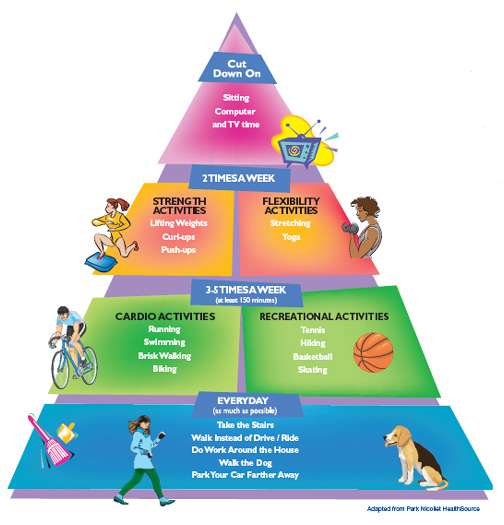
The U.S. Department of Health and Human Services recommends the following physical activity guidelines for adults:
Participate in moderate-intensity cardio physical activity on 3-5 days for a minimum of 150 minutes each week…
Or
Participate in vigorous-intensity cardio physical activity on 3-5 days for a minimum of 75 minutes each week…
And
Perform 8-10 strength-training exercises, 8-12 repetitions of each exercise twice each week.
Understanding and using the recommendation:
ACTIVITY PYRAMID
You may think it’s contrary to your goals to put more calories into your system when you’re sweating it out to burn them off, but exercise is the time your body most needs fuel. Trying to exercise without energy in your system is like trying to coax your car to run when it’s out of gas; you may be able to coast a bit (if you are faced downhill), but you certainly won’t get any power. If you deprive your body of the nutrients it needs to repair and refuel post-workout, you may find that your body does not perform the way you want it the next time you head to the gym. Although some exceptions exist, you are best off eating a healthy snack before and after your workout in order to lose weight.
Before a workout – a real sweat-inducing workout that lasts 45 minutes or longer, not a 20-minute stroll around the block – you need energy, preferably in the form of carbohydrates to get you moving. Carbs are the primary fuel source for the body. Without them, your body doesn’t suddenly start burning a whole lot of fat; instead, it turns to burning lean muscle. A meta analysis published in the “Journal of Strength and Conditioning Research” in February 2011 examined multiple studies on the topic of exercising in a unfed state. The analysis concluded that you will burn about the same amount of fat whether you eat before or after exercising. However, if you don’t eat, your body is more likely to burn muscle in addition to fat, and your intensity and total calorie burn will reduced. Regularly burning off muscle can lower your metabolism and make it harder to lose weight. Having a snack doesn’t have to be huge – 100 to 200 calories will do. Aim for food that is mostly carbohydrates with a little high-quality protein, especially if you plan to do cardio. Some examples are half of a whole-wheat bagel topped with a tablespoon of peanut butter; a banana with some low-fat yogurt; or a few almonds and an apple.
For more information on this article, visit: http://www.livestrong.com/article/399834-is-it-better-to-eat-before-or-after-a-workout-to-lose-weight/
How many calories does physical activity use?
A 154-pound man (5′ 10″) will use up about the number of calories listed doing each activity below. Those who weigh more will use more calories, and those who weigh less will use fewer. The calorie values listed include both calories used by the activity and the calories used for normal body functioning.

Here’s looking at you!
Ah…. the convenience and ease of using technology: personal computers, tablets and cell phones with prolonged usage can often be felt in the eyes. Close to 70 percent of American adults experience some form of digital eyestrain, according to a report from The Vision Council.
Symptoms of digital eyestrain can include dry eyes, blurred vision and headaches.
The organization Prevent Blindness suggests that office workers can take a few simple steps to help prevent eyestrain and fatigue.
According to WEB MD, here are some powerhouse foods to try for healthy eyes (it’s not just carrots anymore!).
Spinach and Kale have antioxidants that protect against eye damage from sunlight, cigarette smoke and air pollution. These leafy greens are loaded with two of the best antioxidants for eyes, lutein and zeaxanthin.
Grapefruit, Strawberries and Brussels Sprouts contain vitamin C, which is a top antioxidant. These foods are among the top sources of vitamin C. Eat half a grapefruit and a handful of Brussels sprouts or strawberries (one-half cup) a day, and you’re good to go. Papaya, oranges and green peppers are other good sources of vitamin C.
Seeds, Nuts and Wheat Germ contain Vitamins C and E that work together to keep healthy tissue strong. But most of us don’t get as much vitamin E as we should from food. Have a small handful of sunflower seeds, or use a tablespoon of wheat germ oil in your salad dressing for a big boost. Almonds, pecans, and vegetable oils are also good sources.
Brought to you in Good EYE Health from Wellness Wednesday!
 TRC STARS/SAFER