Wellness Wednesday – Week 34

Cold, Flu, or Allergy?
Know the Difference for Best Treatment

You’re feeling pretty lousy. You’ve got sniffles, sneezing, and a sore throat. Is it a cold, flu, or allergies? It can be hard to tell them apart because they share so many symptoms. But understanding  the differences will help you choose the best treatment.

“If you know what you have, you won’t take medications  that you don’t need, that aren’t effective, or that might even make your symptoms worse,” says NIH’s Dr. Teresa Hauguel, an expert on infectious diseases that
affect breathing.

Cold, flu, and allergy all affect your respiratory system, which can make it hard to breathe. Each condition has key symptoms that set them apart.

Colds and flu are caused by different viruses. “As a rule of thumb, the symptoms associated with the flu are more severe,” says Hauguel. Both illnesses can lead to a runny, stuffy nose; congestion; cough; and sore throat. But the flu can also cause high fever that lasts for 3-4 days, along with a headache, fatigue, and general aches and pain. These symptoms are less common when you have a cold.

“Allergies are a little different, because they aren’t caused by a virus,” Hauguel explains. “Instead, it’s your body’s immune system reacting to a trigger, or allergen, which is something you’re allergic to.” If you have allergies and breathe in things like pollen or pet dander, the immune cells in your nose and airways may overreact to these harmless substances. Your delicate respiratory tissues may then swell, and your nose may become stuffed up or runny.

“Allergies can also cause itchy, watery eyes, which you don’t normally have with a cold or flu,” Hauguel adds.

Allergy symptoms usually last as long as you’re exposed to the allergen, which may be about 6 weeks during pollen seasons in the spring, summer, or fall. Colds and flu rarely last beyond 2 weeks.

Most people with a cold or flu recover on their own without medical care. But check with a health care provider if symptoms last beyond 10 days or if symptoms aren’t relieved by over-the-counter  medicines. For more about when to see a doctor, go to CDC’s Flu Page .

To treat colds or flu, get plenty of rest and drink lots of fluids. If you have the flu, pain relievers such as aspirin, acetaminophen,  or ibuprofen can reduce fever or aches. Allergies can be treated with antihistamines or decongestants.  See the “Wise Choices” box for more details.

Be careful to avoid “drug overlap” when taking medicines that list 2 or more active ingredients on the label. For example, if you take 2 different drugs that contain acetaminophen—one for a stuffy nose and the other for headache—you  may be getting too much acetaminophen.

“Read medicine labels carefully—the warnings, side effects, dosages. If you have questions, talk to your doctor or pharmacist, especially if you have children who are sick,” Hauguel says. “You don’t want to overmedicate, and you don’t want to risk taking a medication that may interact with another.”
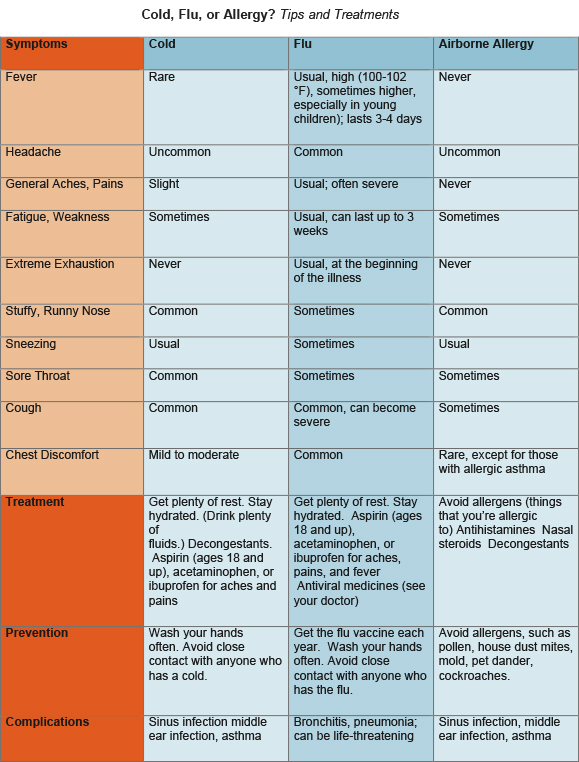
Cold Flu Allergy-3

http://newsinhealth.nih.gov/issue/oct2014/feature2

Wellness Wednesday – Week 30

Have you visited MYPLATE.gov lately?

Healthy tips on Eating, Recipes, Vegetarians, Eating Out, Food Safety, and more.

Starting Points

Your food and physical activity choices each day affect your health — how you feel today, tomorrow, and in the future.

These tips and ideas are a starting point. You will find a wealth of suggestions by going to this site and clicking on the bullet points to get more information on how to get started towards a healthy diet and a healthier you! Try one change that you can make today.

  • Make at least half your grains whole grains
  • Vary your veggies
  • Focus on fruit
  • Get your calcium-rich foods
  • Go lean with protein
  • Get more healthy eating tips

Want more information?  Go to  http://choosemyplate.gov/healthy-eating-tips.html

  1. 10 Tips Nutrition Education Series
  2. Recipes, Cookbooks, and Menus
  3. Tips for Vegetarians
  4. Tips for Eating Healthy When Eating out
  5. Counting Calories in Mixed Dishes
  6. Food Safety Advice
  7. Tips for Increasing Physical Activity

Wellness Wednesday – Week 15

Office snacks may boost morale, but they are also sabotaging your health!

It has been shown that just the sight or smell of candy, cookies, donuts, and the like trigger a desire to eat them.  Since most of us are lugging around some excess body-fat, this kind of morale booster is not helping our diet efforts and is probably inadvertently increasing sick days and perhaps even anxiety, listlessness or moodiness when the resulting sugar rush wears off.

People often think they can work off these snacks with a little extra exercise or activity.  However, just 2 pieces of candy each workday totals about 480 calories and explains why a person weighing 160 pounds would need to walk got 157 minutes; ballroom dance 132 minutes; golf (carrying clubs) 88 minutes; backpack 56 minutes; or run 29 minutes just to burn off those extra calories.

Warning:  You don’t even want to know what it would take to burn off the calories that donuts and cookies contain.  In addition, these sugary treats wreak havoc on your body, spiking insulin levels and making fat burning impossible.   From: Diet & Fat Loss, Men’s Health, TC Lifestyle, Total Health, Women’s Health

Los Angeles nutritionist Jonny Bowden, author of nine books including his most recent, Living Low Carb: Controlled-Carbohydrate Eating for Long Term Weight Loss, writes: “A snack should be a well-constructed mini-meal.  It should be built around adequate protein, a little bit of fat and hopefully some fiber.”  He recommends baking a batch of sweet potatoes and stowing them in the fridge.  “They get sweet and delicious and soft.”  Stuff a little tuna packed in water inside, and pack in a plastic container.  Voila, a tasty mini-meal.

10 Healthy Snacks To Eat At Your Desk

Ideally office snacks should provide 200 calories or less.  But Bowden also recommends even lower-cal choices, like a single hard-boiled egg.  One egg has around 70 calories and is packed with 5 to 6 grams of protein.  Though you should always strive for a balance among fiber, proteins, nutrients, and fats, don’t expect every snack to provide those elements.  Just try to pick a food that’s nutritious and fits in, calorie- and nutrition-wise, with the rest of your diet.
Another snack Bowden loves: half an avocado, which he calls “the unsung hero of the snack kingdom.”  This creamy, green fruit is surprisingly high in fiber, with 9 to 11 grams per avocado.

If you don’t have time to cook sweet potatoes or boil eggs, Bowden recommends some ready-made snacks to grab and stow in your desk drawer.  String cheese, for instance, is high in protein, offers a bit of fat and has only 80 calories.  The Horizon company makes an organic brand that Bowden likes.

Some health bars also make good snacks, Bowden says.  He likes the Lara and Atkins brands.  Lara bars don’t offer protein, but they’re packed with healthy fruit and nuts; Atkins bars have no trans fats, and they’re high in fiber, low in sugar and offer some proteins.  Almonds are another easy, tasty choice to keep on hand.  One ounce, about 12 nuts, has 184 calories and good omega-9 fatty acids, the fat also contained in olive oil that’s associated with heart health.  Almonds also have fiber and protein.

Bowden’s bottom line: Stay away from sugar-rush snacks like chocolate and cookies.  They send your blood sugar soaring, increase your insulin output and signal your kidneys to hold on to sodium.  You may feel a boost in the short term, but in a couple of hours you’ll come crashing down.  You’ll be better off with a balanced mini-meal that keeps your blood sugar steady and contributes to your overall nutrition.

Wellness Wednesday – Week 14

The Power of Almonds

Almonds are high in calories but contain good fats that help reduce bad cholesterol in the blood.  They also curb hunger to ensure that one does not eat too much.  Almonds make a great snack; in addition, they contain vitamin B, magnesium, prosperous, and copper, which are necessary minerals for good health.

For people who are diabetic or pre-diabetic, almonds are good for blood sugar control.  Here’s why:

The Centers for Disease Control estimate that 23.7 million Americans have diabetes and another 54 million Americans have metabolic syndrome or “pre-diabetes.”

Diabetes and pre-diabetes are conditions in which sugar, or glucose, levels in the blood begin to increase. The American Diabetes Association defines a normal fasting blood sugar as less than 100 milligrams per deciliter (mg/dl).  Those with a fasting blood glucose level of greater than 126 mg/dl are suspected of having diabetes, and those with a fasting blood sugar between 100 and 126 mg/dl; as pre-diabetic or insulin resistant.

The good news is that some 60 percent of pre-diabetic individuals can stop the onset of diabetes with a healthy diet and increased activity levels.  Diets with controlled amounts of complex carbohydrates, such as whole grains, fruits and vegetables, are ideal for those with insulin resistance.

Finding wholesome snacks that help to regulate blood sugar levels can often create a challenge for those who are keeping a watchful eye on their diet.  A handful of almonds contains 5 grams of carbohydrates per ounce.  This is one of the reasons why almonds have a low “glycemic index” of 24.5.  Researchers use the glycemic index to rate how quickly the carbohydrates in foods convert into blood sugar.  Foods with a rating of 55 or less are considered low because their carbohydrates trickle slowly into the blood stream.  The slower their rate of entry into the blood stream, the lower their effect upon blood sugar levels and the easier they are for the body to process.  So…. go nuts for Almonds!

According to the USDA:
Just one almond – Calories: 6, Total Fat: 0.61g, Total Carbs: 0.24g, Protein: 0.26g
1 ounce of almonds –  Calories: 164, Total Fat: 14.35g, Total Carbs: 5.65g, Protein: 6.22g
1 cup, whole almonds –  Calories: 826, Total Fat: 72.42g, Total Carbs: 28.23g, Protein: 30.4g
1 cup sliced almonds – Calories: 531, Total Fat: 46.59g, Total Carbs: 18.16g, Protein: 19.56g
Almond butter, no salt 1 tbsp –  Calories: 101, Total Fat: 9.46g, Total Carbs: 3.4g, Protein: 2.41g

Wellness Wednesday – Week 13

Happy Spring!   No Fooling, Doc. 

Spring is a time for renewal, warmth, and growth.  Some of us are still battling feelings of fatigue from the start of seasonal allergies and/or the lingering remnants of the flu season.   Some of us may be feeling heavier this time of year from the holiday feasts enjoyed with family and friends.  All in all, April represents readiness for change in weather and change in all of us.

A common herb called turmeric has potent healing properties.  According to a 2014 meta-study in the journal Biotechnology Advances, there are more than 6,000 articles on turmeric’s antioxidant, anti-inflammatory, anti-bacterial, anti-viral, and anti-cancer properties. Turmeric has an orange coloring and has several uses to combat colds and fatigue.

According to an article in Yoga Journal, take a cup of morning tea using ¼ teaspoon of ginger and ¼ teaspoon of turmeric.  This will wake up your digestive system and take care of aches and pains from flu or arthritis.  Turmeric is also effective at drying mucus and soothing irritation associated with allergies and colds.  To tackle the sniffles, take ½ teaspoon of turmeric powder with equal part of raw honey to help clear phlegm, three times a day.

Use turmeric every day and sprinkle on your vegetables for extra flavor and good health.  The recipe below I have tried for something different to serve for dinner.  I serve it over a bed of brown short-grain rice.

Cauliflower Steaks with Ginger, Turmeric, and Cumin (recipe from The Kitchen)

Serves 3

  • 1 large head cauliflower
  • Salt and pepper
  • 2 tablespoons olive oil, divided
  • 1 teaspoon freshly grated ginger
  • 1 teaspoon ground cumin
  • 1/2 teaspoon ground turmeric
  • Small handful of cilantro, chopped  ………….. Preheat the oven to 400°F.

Remove the leaves and trim the stem end of the cauliflower, leaving the core intact.  Using a large knife, cut the cauliflower from top to base into three, 3/4-inch-thick “steaks.” Season each steak with salt and pepper on both sides. (Reserve any loose florets for another use.)

Heat 1 tablespoon of olive oil in a large skillet over medium-high heat.  Sear the cauliflower steaks until golden brown, about 2 minutes on each side.  Gently transfer the steaks to a baking sheet.

Whisk together the remaining 1 tablespoon of olive oil, ginger, cumin, and turmeric.  Brush or spoon the mixture onto the cauliflower steaks.

Roast in the oven until tender, about 15 minutes.  Garnish with cilantro and serve.

Wellness Wednesday – Week 12

The U.S. Department of Health and Human Services recommends the following physical activity guidelines for adults:

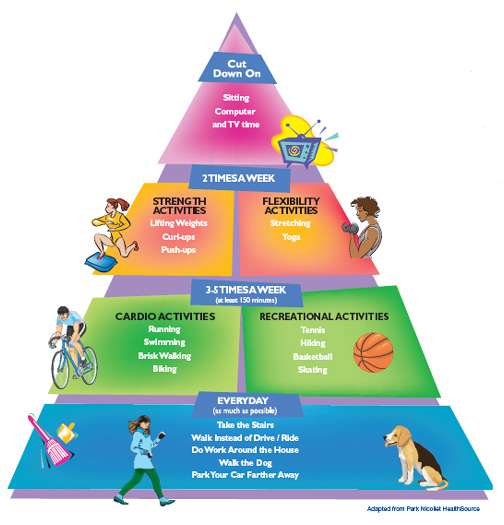
Participate in moderate-intensity cardio physical activity on 3-5 days for a minimum of 150 minutes each week…

Or

Participate in vigorous-intensity cardio physical activity on 3-5 days for a minimum of 75 minutes each week…

And

Perform 8-10 strength-training exercises, 8-12 repetitions of each exercise twice each week.

Understanding and using the recommendation:

  • Cardio or aerobic activity will help strengthen your heart and lungs, and manage weight.
  • Moderate-intensity cardio activity means you are working hard enough to raise your heart rate, but are still able to talk while doing the activity.  Examples of moderate-intensity activities are: walking, biking, swimming, and group aerobics.
  • Vigorous-intensity cardio activity means you are breathing hard and fast, and your heart rate has gone up quite a bit.  Examples of vigorous intensity activities are: jogging and swimming laps.
  • Strength training helps to strengthen muscles and maintain lean muscle tissue.  Examples of strength training activities are: lifting weights, using resistance bands, doing curl-ups and push-ups.
  • Check with your health care provider before you begin a moderate-intensity physical activity program.
  • Choose activities that you will enjoy.
  • Begin slowly and set a realistic goal – “I will take a 10-minute walk during lunch on 3 days each week.”
  • Record and reward your progress.
  • Get support from family and friends.
  • Plan for problems – have an indoor activity plan for bad weather days

ACTIVITY PYRAMID

pyramid