Wellness Wednesday – Week 19

Interested in shedding some federal student loan debt?

If you plan things just right, there’s a strategy that may work for you. It’s called the Public Service Loan Forgiveness  program at https://studentaid.ed.gov/sa/repay-loans/forgiveness-cancellation/public-service#page .

Here are the requirements:

  • You must work full-time for a public service employer—a government agency or a non-profit organization. (Not all non-profits qualify.)
  • You must have a qualifying loan and a qualifying repayment plan. (You can restructure both so they meet the requirements.)
  • You must make 120 qualifying payments, all while meeting the points above.

Read  http://www.ed.gov/blog/2015/04/how-to-qualify-for-public-service-loan-forgiveness-2/ for a step-by-step explanation of how to qualify for each requirement

Wellness Wednesday – Week 18

Are you at risk for Gynecologic Cancer?

According to an article from the Cancer Treatment Centers of America, roughly 71,500 women in the United States are diagnosed with gynecologic cancer each year.  The risk of cancer increases with age.  Endometrial/uterine cancer affects more than 52,000 women annually in the United States.

Cervical cancer tends to occur in midlife.  Most cases are found in women under the age of 50, and it is linked to human papilloma viruses.

Endometrial cancer is rare for women under the age of 45; most cases are found in women over 50.

Ovarian cancer affects up to 5% of women who have it in their family histories.  It has the highest mortality of the gynecologic cancers, killing more than 14,000 women annually in the United States.

Take Preventive Action

Make healthy choices for yourself!  Eat a well-balanced diet; maintain an active lifestyle; quit or avoid smoking; maintain a healthy weight; and follow safe sex practices.

Pay attention to your body.  Some common warning signs for ovarian cancer are abdominal bloating; indigestion or nausea; changes in appetite; feeling pressure in the pelvis or lower back; changes in bowel movements; increased abdominal girth, and feeling tired or having low energy.

Make time for an annual physical.  Educate yourself on your health history and your family’s health history.  Having close relatives on either side of the family who have had ovarian cancer increases a woman’s chance of developing ovarian cancer.

Eat Healthy
Reduce your risk for cancer by improving your diet.  New research shows that as many as one-third of all cancer deaths are linked to diet and physical activity.

You have the power to change your eating habits.
Start by reducing dietary fat intake, especially animal fat.  Make your diet rich in fruits, vegetables, nuts, beans, and whole grains.

Start small
No one can overhaul food habits quickly.  Add a few servings of fruits and vegetables to your diet each day to reduce your cancer risk.  Mix some dark, leafy greens like spinach in with your salad.  Eat a peach, or other brightly colored fruit, for a snack.

Limit alcohol
Alcohol consumption is linked to increased risk of mouth, esophagus, pharynx, larynx, liver, and breast cancers.  If you drink alcohol, men should try to drink no more than two drinks a day, and women should try to drink no more than one drink a day.

Eat less red meat and cut out processed meat
Eating too much red meat can increase your cancer risk.  Skip processed meats such as bacon, ham, pastrami, salami, sausage, hot dogs, and pepperoni.  Choose fish, poultry or beans instead of beef, pork or lamb.  When you eat meat, choose lean cuts, and eat smaller portions.  Prepare meat by baking, broiling or poaching at lower temperatures, rather than by frying in fat or broiling/grilling at excessively high temperatures.

Resource: http://preventcancer.org/prevention/reduce-cancer-risk/ways-to-reduce-risk/eat-healthy/

Wellness Wednesday – Week 17

Learn About the Safer Choice Label

EPA-Environmental Protection Agency reports a new label:

Time for Spring Cleaning?  Check out the new label for environmental safety factors for you, your home, and family.

LOOK FOR THE SAFER CHOICE LABEL.

safe choice

Finding cleaning and other products that are safer for you, your family, and the environment should be easy — that’s why the EPA developed a new “Safer Choice” label. All of us play a role in protecting our families’ health and the environment. Products with the Safer Choice label help consumers and commercial buyers identify and select products with safer chemical ingredients, without sacrificing quality or performance.

More than 2,000 products currently qualify to carry the Safer Choice label. Safer Choice products are available for your home at retail stores and for use in businesses like schools, hotels, offices, and sports venues.

For more information on products available go to :  http://www2.epa.gov/saferchoice

Wellness Wednesday – Week 16

Tips for Power Walking

By Kara Mayer Robinson  From WEBMD

You do not have to be a runner to be fit.  Every hour you spend walking may add 2 hours to your life, research suggests. Brisk walking can help trim your risk of heart disease, stroke, type 2 diabetes, cancer, and depression. To reap the benefits of walking and stay injury-free, try these tips.

Wear comfy, well-fitting shoes. They should be lightweight and breathable. Look for thick cushioning in the heel, good support, and flexibility. Replace them after 3 to 6 months.

Start with a warm-up. Stroll at a comfortable pace for 5 to 10 minutes. Then pick it up for the rest of your walk.

Set goals. Aim for four to six walks every week. “If you’re a beginner, shoot for 20 to 30 minutes. If you’re more advanced, take it up to 45- or 60-minute sessions.

Stand tall. Pay attention to your posture. Keep your head up, stomach in, and shoulders relaxed. Lift your chest and engage your abs.

Stride naturally. Point your toes and knees forward. Straighten your front leg but don’t lock your knee. Try to land on your heel instead of the middle or front of your foot, then roll your weight forward. Use a natural step length and avoid over-striding.

Squeeze and tighten. Squeeze your glutes and engage your core to strengthen your muscles and cut your risk of injury.

Swing your arms. Keep your shoulders relaxed so your arms swing freely, and so your back and neck don’t tense up. Keep your arms bent. Swinging them will propel you forward and help you move faster. Don’t use hand weights. They put stress on your elbows and shoulders.

Try intervals. They’re great for endurance and weight loss. Speed up for a minute or 2 every 5 minutes….Or alternate one fast block with one or two slower blocks.

Cool down. Walk at a slower pace for 5 to 10 minutes. Then stretch your hamstrings, calves, chest, shoulders, and back.

Wellness Wednesday – Week 15

Office snacks may boost morale, but they are also sabotaging your health!

It has been shown that just the sight or smell of candy, cookies, donuts, and the like trigger a desire to eat them.  Since most of us are lugging around some excess body-fat, this kind of morale booster is not helping our diet efforts and is probably inadvertently increasing sick days and perhaps even anxiety, listlessness or moodiness when the resulting sugar rush wears off.

People often think they can work off these snacks with a little extra exercise or activity.  However, just 2 pieces of candy each workday totals about 480 calories and explains why a person weighing 160 pounds would need to walk got 157 minutes; ballroom dance 132 minutes; golf (carrying clubs) 88 minutes; backpack 56 minutes; or run 29 minutes just to burn off those extra calories.

Warning:  You don’t even want to know what it would take to burn off the calories that donuts and cookies contain.  In addition, these sugary treats wreak havoc on your body, spiking insulin levels and making fat burning impossible.   From: Diet & Fat Loss, Men’s Health, TC Lifestyle, Total Health, Women’s Health

Los Angeles nutritionist Jonny Bowden, author of nine books including his most recent, Living Low Carb: Controlled-Carbohydrate Eating for Long Term Weight Loss, writes: “A snack should be a well-constructed mini-meal.  It should be built around adequate protein, a little bit of fat and hopefully some fiber.”  He recommends baking a batch of sweet potatoes and stowing them in the fridge.  “They get sweet and delicious and soft.”  Stuff a little tuna packed in water inside, and pack in a plastic container.  Voila, a tasty mini-meal.

10 Healthy Snacks To Eat At Your Desk

Ideally office snacks should provide 200 calories or less.  But Bowden also recommends even lower-cal choices, like a single hard-boiled egg.  One egg has around 70 calories and is packed with 5 to 6 grams of protein.  Though you should always strive for a balance among fiber, proteins, nutrients, and fats, don’t expect every snack to provide those elements.  Just try to pick a food that’s nutritious and fits in, calorie- and nutrition-wise, with the rest of your diet.
Another snack Bowden loves: half an avocado, which he calls “the unsung hero of the snack kingdom.”  This creamy, green fruit is surprisingly high in fiber, with 9 to 11 grams per avocado.

If you don’t have time to cook sweet potatoes or boil eggs, Bowden recommends some ready-made snacks to grab and stow in your desk drawer.  String cheese, for instance, is high in protein, offers a bit of fat and has only 80 calories.  The Horizon company makes an organic brand that Bowden likes.

Some health bars also make good snacks, Bowden says.  He likes the Lara and Atkins brands.  Lara bars don’t offer protein, but they’re packed with healthy fruit and nuts; Atkins bars have no trans fats, and they’re high in fiber, low in sugar and offer some proteins.  Almonds are another easy, tasty choice to keep on hand.  One ounce, about 12 nuts, has 184 calories and good omega-9 fatty acids, the fat also contained in olive oil that’s associated with heart health.  Almonds also have fiber and protein.

Bowden’s bottom line: Stay away from sugar-rush snacks like chocolate and cookies.  They send your blood sugar soaring, increase your insulin output and signal your kidneys to hold on to sodium.  You may feel a boost in the short term, but in a couple of hours you’ll come crashing down.  You’ll be better off with a balanced mini-meal that keeps your blood sugar steady and contributes to your overall nutrition.

Wellness Wednesday – Week 14

The Power of Almonds

Almonds are high in calories but contain good fats that help reduce bad cholesterol in the blood.  They also curb hunger to ensure that one does not eat too much.  Almonds make a great snack; in addition, they contain vitamin B, magnesium, prosperous, and copper, which are necessary minerals for good health.

For people who are diabetic or pre-diabetic, almonds are good for blood sugar control.  Here’s why:

The Centers for Disease Control estimate that 23.7 million Americans have diabetes and another 54 million Americans have metabolic syndrome or “pre-diabetes.”

Diabetes and pre-diabetes are conditions in which sugar, or glucose, levels in the blood begin to increase. The American Diabetes Association defines a normal fasting blood sugar as less than 100 milligrams per deciliter (mg/dl).  Those with a fasting blood glucose level of greater than 126 mg/dl are suspected of having diabetes, and those with a fasting blood sugar between 100 and 126 mg/dl; as pre-diabetic or insulin resistant.

The good news is that some 60 percent of pre-diabetic individuals can stop the onset of diabetes with a healthy diet and increased activity levels.  Diets with controlled amounts of complex carbohydrates, such as whole grains, fruits and vegetables, are ideal for those with insulin resistance.

Finding wholesome snacks that help to regulate blood sugar levels can often create a challenge for those who are keeping a watchful eye on their diet.  A handful of almonds contains 5 grams of carbohydrates per ounce.  This is one of the reasons why almonds have a low “glycemic index” of 24.5.  Researchers use the glycemic index to rate how quickly the carbohydrates in foods convert into blood sugar.  Foods with a rating of 55 or less are considered low because their carbohydrates trickle slowly into the blood stream.  The slower their rate of entry into the blood stream, the lower their effect upon blood sugar levels and the easier they are for the body to process.  So…. go nuts for Almonds!

According to the USDA:
Just one almond – Calories: 6, Total Fat: 0.61g, Total Carbs: 0.24g, Protein: 0.26g
1 ounce of almonds –  Calories: 164, Total Fat: 14.35g, Total Carbs: 5.65g, Protein: 6.22g
1 cup, whole almonds –  Calories: 826, Total Fat: 72.42g, Total Carbs: 28.23g, Protein: 30.4g
1 cup sliced almonds – Calories: 531, Total Fat: 46.59g, Total Carbs: 18.16g, Protein: 19.56g
Almond butter, no salt 1 tbsp –  Calories: 101, Total Fat: 9.46g, Total Carbs: 3.4g, Protein: 2.41g

Wellness Wednesday – Week 13

Happy Spring!   No Fooling, Doc. 

Spring is a time for renewal, warmth, and growth.  Some of us are still battling feelings of fatigue from the start of seasonal allergies and/or the lingering remnants of the flu season.   Some of us may be feeling heavier this time of year from the holiday feasts enjoyed with family and friends.  All in all, April represents readiness for change in weather and change in all of us.

A common herb called turmeric has potent healing properties.  According to a 2014 meta-study in the journal Biotechnology Advances, there are more than 6,000 articles on turmeric’s antioxidant, anti-inflammatory, anti-bacterial, anti-viral, and anti-cancer properties. Turmeric has an orange coloring and has several uses to combat colds and fatigue.

According to an article in Yoga Journal, take a cup of morning tea using ¼ teaspoon of ginger and ¼ teaspoon of turmeric.  This will wake up your digestive system and take care of aches and pains from flu or arthritis.  Turmeric is also effective at drying mucus and soothing irritation associated with allergies and colds.  To tackle the sniffles, take ½ teaspoon of turmeric powder with equal part of raw honey to help clear phlegm, three times a day.

Use turmeric every day and sprinkle on your vegetables for extra flavor and good health.  The recipe below I have tried for something different to serve for dinner.  I serve it over a bed of brown short-grain rice.

Cauliflower Steaks with Ginger, Turmeric, and Cumin (recipe from The Kitchen)

Serves 3

  • 1 large head cauliflower
  • Salt and pepper
  • 2 tablespoons olive oil, divided
  • 1 teaspoon freshly grated ginger
  • 1 teaspoon ground cumin
  • 1/2 teaspoon ground turmeric
  • Small handful of cilantro, chopped  ………….. Preheat the oven to 400°F.

Remove the leaves and trim the stem end of the cauliflower, leaving the core intact.  Using a large knife, cut the cauliflower from top to base into three, 3/4-inch-thick “steaks.” Season each steak with salt and pepper on both sides. (Reserve any loose florets for another use.)

Heat 1 tablespoon of olive oil in a large skillet over medium-high heat.  Sear the cauliflower steaks until golden brown, about 2 minutes on each side.  Gently transfer the steaks to a baking sheet.

Whisk together the remaining 1 tablespoon of olive oil, ginger, cumin, and turmeric.  Brush or spoon the mixture onto the cauliflower steaks.

Roast in the oven until tender, about 15 minutes.  Garnish with cilantro and serve.

Wellness Wednesday – Week 12

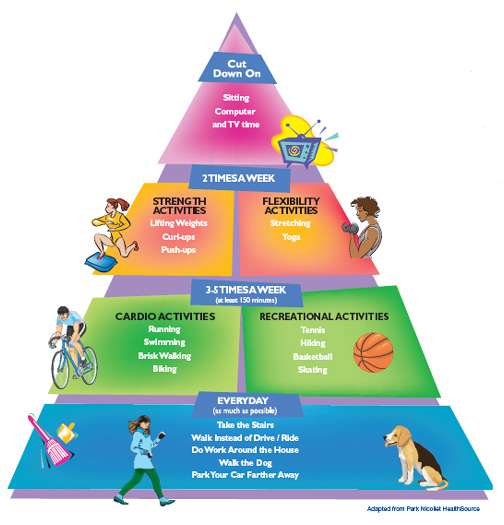
The U.S. Department of Health and Human Services recommends the following physical activity guidelines for adults:

Participate in moderate-intensity cardio physical activity on 3-5 days for a minimum of 150 minutes each week…

Or

Participate in vigorous-intensity cardio physical activity on 3-5 days for a minimum of 75 minutes each week…

And

Perform 8-10 strength-training exercises, 8-12 repetitions of each exercise twice each week.

Understanding and using the recommendation:

  • Cardio or aerobic activity will help strengthen your heart and lungs, and manage weight.
  • Moderate-intensity cardio activity means you are working hard enough to raise your heart rate, but are still able to talk while doing the activity.  Examples of moderate-intensity activities are: walking, biking, swimming, and group aerobics.
  • Vigorous-intensity cardio activity means you are breathing hard and fast, and your heart rate has gone up quite a bit.  Examples of vigorous intensity activities are: jogging and swimming laps.
  • Strength training helps to strengthen muscles and maintain lean muscle tissue.  Examples of strength training activities are: lifting weights, using resistance bands, doing curl-ups and push-ups.
  • Check with your health care provider before you begin a moderate-intensity physical activity program.
  • Choose activities that you will enjoy.
  • Begin slowly and set a realistic goal – “I will take a 10-minute walk during lunch on 3 days each week.”
  • Record and reward your progress.
  • Get support from family and friends.
  • Plan for problems – have an indoor activity plan for bad weather days

ACTIVITY PYRAMID

pyramid

Wellness Wednesday – Week 11

You may think it’s contrary to your goals to put more calories into your system when you’re sweating it out to burn them off, but exercise is the time your body most needs fuel.  Trying to exercise without energy in your system is like trying to coax your car to run when it’s out of gas; you may be able to coast a bit (if you are faced downhill), but you certainly won’t get any power. If you deprive your body of the nutrients it needs to repair and refuel post-workout, you may find that your body does not perform the way you want it the next time you head to the gym.  Although some exceptions exist, you are best off eating a healthy snack before and after your workout in order to lose weight.

Before a workout – a real sweat-inducing workout that lasts 45 minutes or longer, not a 20-minute stroll around the block – you need energy, preferably in the form of carbohydrates to get you moving.  Carbs are the primary fuel source for the body.  Without them, your body doesn’t suddenly start burning a whole lot of fat; instead, it turns to burning lean muscle.  A meta analysis published in the “Journal of Strength and Conditioning Research” in February 2011 examined multiple studies on the topic of exercising in a unfed state.  The analysis concluded that you will burn about the same amount of fat whether you eat before or after exercising.  However, if you don’t eat, your body is more likely to burn muscle in addition to fat, and your intensity and total calorie burn will reduced.  Regularly burning off muscle can lower your metabolism and make it harder to lose weight.  Having a snack doesn’t have to be huge – 100 to 200 calories will do.  Aim for food that is mostly carbohydrates with a little high-quality protein, especially if you plan to do cardio.  Some examples are half of a whole-wheat bagel topped with a tablespoon of peanut butter; a banana with some low-fat yogurt; or a few almonds and an apple.

For more information on this article, visit: http://www.livestrong.com/article/399834-is-it-better-to-eat-before-or-after-a-workout-to-lose-weight/

How many calories does physical activity use?

A 154-pound man (5′ 10″) will use up about the number of calories listed doing each activity below.  Those who weigh more will use more calories, and those who weigh less will use fewer.  The calorie values listed include both calories used by the activity and the calories used for normal body functioning.

wellness image

Wellness Wednesday – Week 10

March is Workplace Eye Wellness Month!

Here’s looking at you!

Ah…. the convenience and ease of using technology: personal computers, tablets and cell phones with prolonged usage can often be felt in the eyes.  Close to 70 percent of American adults experience some form of digital eyestrain, according to a report from The Vision Council.

Symptoms of digital eyestrain can include dry eyes, blurred vision and headaches.

The organization Prevent Blindness suggests that office workers can take a few simple steps to help prevent eyestrain and fatigue.

  1. Visit an eye doctor for a dilated eye exam to make sure you are seeing clearly
    and to detect any potential vision issues.
  2. Place your screen 20 to 26 inches away from your eyes and a little bit below eye
    level.
  3. Use a document holder placed next to your computer screen.  It should be close
    enough so you don’t have to swing your head back and forth or constantly
    change your eye focus.
  4. Adjust the text size on the screen to a comfortable level.
  5. Change your lighting to lower glare and harsh reflections.  Installing a glare filter over your computer screen can also help.
  6. Use a chair that you can adjust.
  7. Choose screens that can tilt and swivel.  A keyboard that you can adjust is also
    helpful.
  8. The Vision Council recommends the 20-20-20 break: every 20 minutes, take a
    20-second break and look at something 20 feet away.

According to WEB MD, here are some powerhouse foods to try for healthy eyes (it’s not just carrots anymore!).

Spinach and Kale have antioxidants that protect against eye damage from sunlight, cigarette smoke and air pollution.  These leafy greens are loaded with two of the best antioxidants for eyes, lutein and zeaxanthin.

Grapefruit, Strawberries and Brussels Sprouts contain vitamin C, which is a top antioxidant.  These foods are among the top sources of vitamin C.  Eat half a grapefruit and a handful of Brussels sprouts or strawberries (one-half cup) a day, and you’re good to go.  Papaya, oranges and green peppers are other good sources of vitamin C.

Seeds, Nuts and Wheat Germ contain Vitamins C and E that work together to keep healthy tissue strong. But most of us don’t get as much vitamin E as we should from food. Have a small handful of sunflower seeds, or use a tablespoon of wheat germ oil in your salad dressing for a big boost. Almonds, pecans, and vegetable oils are also good sources.

Brought to you in Good  EYE Health from Wellness Wednesday!