









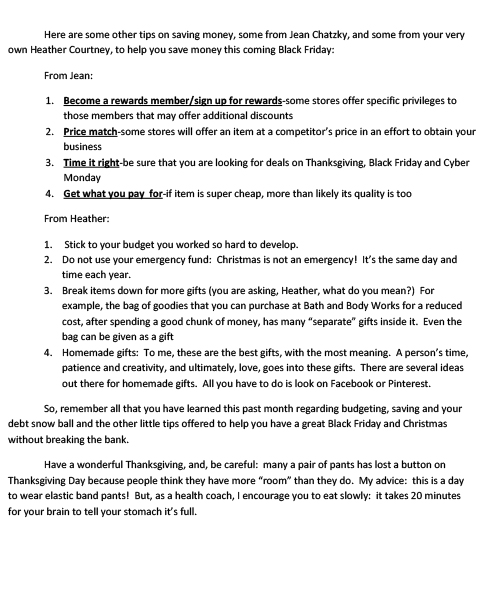

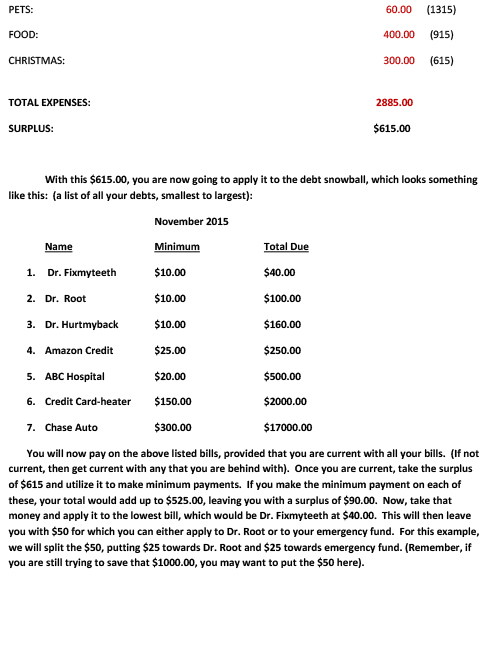


Here at STARS, we decided that for November’s Wellness Wednesdays, we would focus on budgeting. With the Christmas season right around the corner, and the start of a new year, spending money becomes a way of life for most folks. We are hoping that the little tips and tricks that are shared on Wellness Wednesdays, and the budgeting Lunch and Learns throughout November, will assist you in planning for the holidays, and essentially, the future, without breaking the bank.
For our first Wednesday, we are going to focus on basic definitions in regards to money and budgeting. These definitions, while common, need to be truly understood for a successful and less stress filled holiday season, and beyond.
David Ramsey is a well known author (The Total Money Makeover and Financial Peace) and radio talk show host of The Dave Ramsey Show who has written several books on getting out of debt, money matters, and budgeting. We will be using his ideas/theories throughout the month, and during the Lunch and Learns, in an effort to assist you in creating a budget, maintaining a budget and paying off debt.
LET’S GET STARTED
Budget:
Both of these components define a budget. A budget is a financial plan that takes into account how much income is earned for a set period of time and what expenditures are for the same set period of time.
Income:
Expenditures:
Debt:
There is a definite negative connotation to the word debt. It feels like a heavy weight if you have debt. Am I right?
Focus:
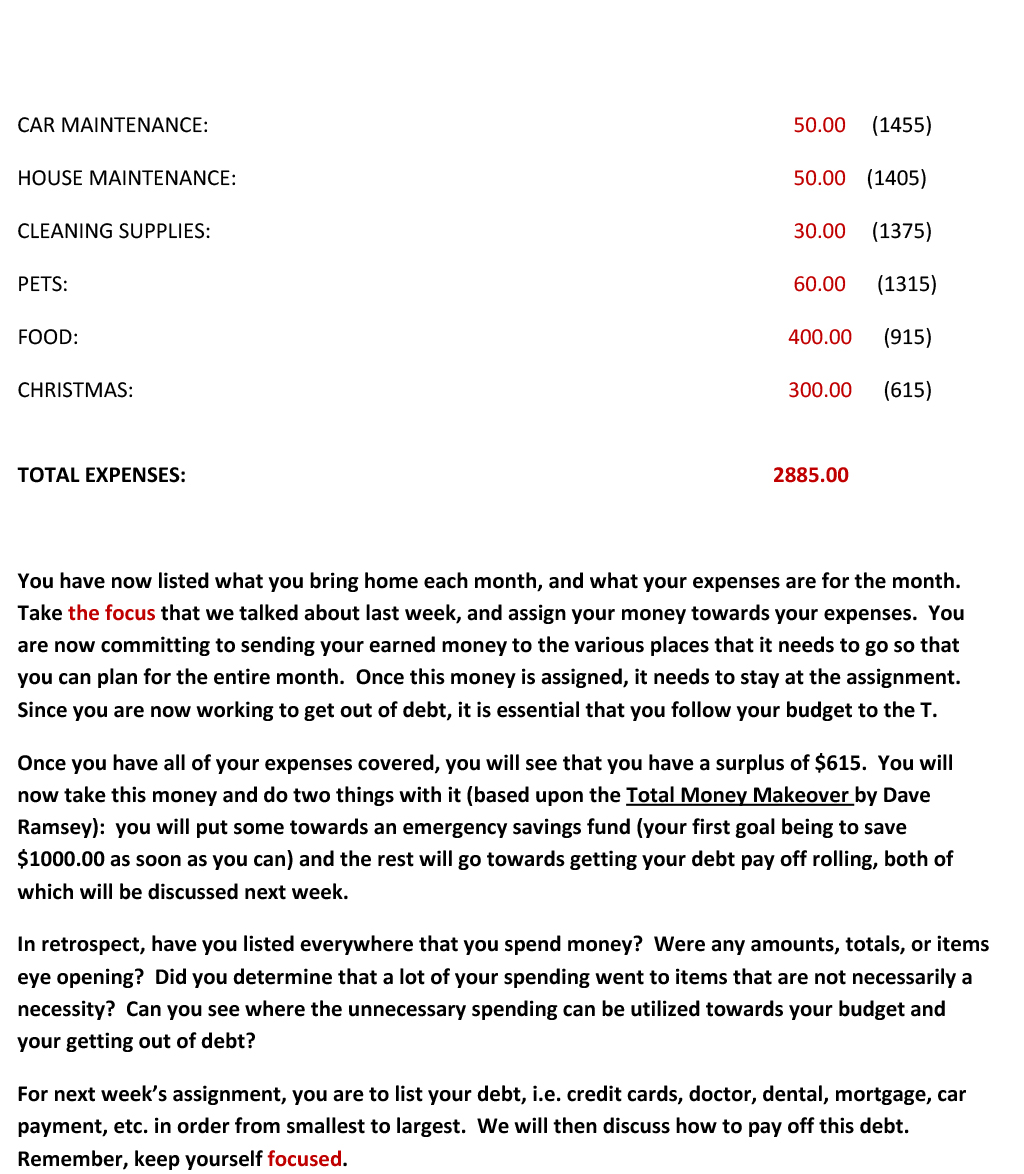
It is your responsibility, as a single person, married couple, head of household, to determine how much money you will bring in for the month. You then determine what bills/purchases you have for the month. Once both of those totals have been figured, you need to send your money to the places where it needs to go.
It takes a lot of focus to create and stick to a budget. You have to stick to your created budget in order to lessen the debt that you may have. Imagine your debt becoming less and less as you follow the budget you have established. Would that not feel wonderful? There is a definite feeling of accomplishment and relief when you are working toward alleviating your debt.
For next week, your homework assignment is as follows:
Once you have done that, we will put that information on forms (cheat sheets, so to speak) so that you can see where your money is going. This is extremely helpful to see where your money is going as we continue this process.
Until next week, be mindful of your income and your purchases/expenses. This is the first step in alleviating debt. Knowing how much you make and seeing where your money is going can be very eye opening…
Sleep plays a vital role in good health and well-being throughout your life. Getting enough quality sleep at the right times can help protect your mental health, physical health, quality of life, and safety.
The way you feel while you’re awake depends in part on what happens while you’re sleeping. During sleep, your body is working to support healthy brain function and maintain your physical health. In children and teens, sleep also helps support growth and development.
The damage from sleep deficiency can occur in an instant (such as a car crash), or it can harm you over time. For example, ongoing sleep deficiency can raise your risk for some chronic health problems. It also can affect how well you think, react, work, learn, and get along with others.
Healthy Brain Function and Emotional Well-Being
Sleep helps your brain work properly. While you’re sleeping, your brain is preparing for the next day. It’s forming new pathways to help you learn and remember information.
Studies show that a good night’s sleep improves learning. Whether you’re learning math, how to play the piano, how to perfect your golf swing, or how to drive a car, sleep helps enhance your learning and problem-solving skills. Sleep also helps you pay attention, make decisions, and be creative.
Studies also show that sleep deficiency alters activity in some parts of the brain. If you’re sleep deficient, you may have trouble making decisions, solving problems, controlling your emotions and behavior, and coping with change. Sleep deficiency also has been linked to depression, suicide, and risk-taking behavior.
Children and teens who are sleep deficient may have problems getting along with others. They may feel angry and impulsive, have mood swings, feel sad or depressed, or lack motivation. They also may have problems paying attention, and they may get lower grades and feel stressed.
Physical Health
Sleep plays an important role in your physical health. For example, sleep is involved in healing and repair of your heart and blood vessels. Ongoing sleep deficiency is linked to an increased risk of heart disease, kidney disease, high blood pressure, diabetes, and stroke.
Sleep deficiency also increases the risk of obesity. For example, one study of teenagers showed that with each hour of sleep lost, the odds of becoming obese went up. Sleep deficiency increases the risk of obesity in other age groups as well.
Sleep helps maintain a healthy balance of the hormones that make you feel hungry (ghrelin) or full (leptin). When you don’t get enough sleep, your level of ghrelin goes up and your level of leptin goes down. This makes you feel hungrier than when you’re well-rested.
Sleep also affects how your body reacts to insulin, the hormone that controls your blood glucose (sugar) level. Sleep deficiency results in a higher than normal blood sugar level, which may increase your risk for diabetes.
Sleep also supports healthy growth and development. Deep sleep triggers the body to release the hormone that promotes normal growth in children and teens. This hormone also boosts muscle mass and helps repair cells and tissues in children, teens, and adults. Sleep also plays a role in puberty and fertility.
Your immune system relies on sleep to stay healthy. This system defends your body against foreign or harmful substances. Ongoing sleep deficiency can change the way in which your immune system responds. For example, if you’re sleep deficient, you may have trouble fighting common infections.
Daytime Performance and Safety
Getting enough quality sleep at the right times helps you function well throughout the day. People who are sleep deficient are less productive at work and school. They take longer to finish tasks, have a slower reaction time, and make more mistakes.
After several nights of losing sleep—even a loss of just 1–2 hours per night—your ability to function suffers as if you haven’t slept at all for a day or two.
Lack of sleep also may lead to microsleep. Microsleep refers to brief moments of sleep that occur when you’re normally awake.
You can’t control microsleep, and you might not be aware of it. For example, have you ever driven somewhere and then not remembered part of the trip? If so, you may have experienced microsleep.
Even if you’re not driving, microsleep can affect how you function. If you’re listening to a lecture, for example, you might miss some of the information or feel like you don’t understand the point. In reality, though, you may have slept through part of the lecture and not been aware of it.
Some people aren’t aware of the risks of sleep deficiency. In fact, they may not even realize that they’re sleep deficient. Even with limited or poor-quality sleep, they may still think that they can function well.
For example, drowsy drivers may feel capable of driving. Yet, studies show that sleep deficiency harms your driving ability as much as, or more than, being drunk. It’s estimated that driver sleepiness is a factor in about 100,000 car accidents each year, resulting in about 1,500 deaths.
Drivers aren’t the only ones affected by sleep deficiency. It can affect people in all lines of work, including health care workers, pilots, students, lawyers, mechanics, and assembly line workers.
As a result, sleep deficiency is not only harmful on a personal level, but it also can cause large-scale damage. For example, sleep deficiency has played a role in human errors linked to tragic accidents, such as nuclear reactor meltdowns, grounding of large ships, and aviation accidents.
http://www.nhlbi.nih.gov/health/health-topics/topics/sdd/why